Thou shalt not bear false witness against thy neighbour. Exodus 20:16
In fact: “Love your neighbour as yourself” Mk 12:31
…”bearing with one another, and forgiving each other, whoever has a complaint against anyone; just as the Lord forgave you, so must you do also.” Col 3:13
Paul's Blog
Quick Note
If anything on this site feels off or unintentionally bothersome, feel free to pass the word along. I'm happy to take a look and adjust if it helps. Everything here is meant to inspire, assist, and amuse.....not upset.
April 12, 2026
Today is Divine Mercy Sunday - UPDATED
I fullfilled all of the requirements for the plenary indulgence.
I am not a long term or strong devotee of the Divine Mercy adherence. I our bedroom, my wife had a big picture of the Christ pouring Grace and mercy from his heart. I saw the art as surreal, realistic but too close to reality. Almost creepy valley in it's rendering. I did understand the idea and appreciated it. I did not pour myself into it as I saw it as something she was interested in. I remained curious. So, she introduced the devotion to me. I was into Isaiah 6:1-8. As stated below, I heard it exercised in a morning catholic men's group through a talk by Tim Bolluck. That triggered my recent attension.
After the talk Charley Vaughn (Deacon) reminded the group that Divine Mercy Sunday is this Sunday. To participate in the Plenary Indulgence, visit this link:
Another link to a different site about the Divine Mercy Indulgence:
I have every intention to properly complete the requirements of the Indulgence today. Charley said it is like a "NEW BAPTISM".
I have every intention to sin no more, even venally, to pray for the intentions of Pope Leo XIV, to receive absolution, and to receive the Eucharist.
Please pray that I get this done. :) UPDATE - I got it done.
This may sound corrupt to my non-catholic friends since there is a lingering narrative from the middle ages and the renaissance when indulgences were sold by corrupt church officials, one of the complaints of Martin Luther (who carried his own catalogue of sin). This is a gift to the faithful without a transaction. The deal if there is one? Ask for forgiveness and you receive it. That is it. Just ask Jesus to take your heart and that you trust in Him, and you are showered in His mercy.
Infinite hospitality... Three persons loved each other so much that their love overflowed and created beauty, truth and goodness, all that is visible and invisible. Us. Our love for each other.
Sunday Peace - Coffee and Reverent Silence.
Having an inner conversation about my day and my week. In total silence. All I hear is my keyboard clicking.
Other Matters
Judicial Reviews
There is a hearing this week for JR PtH No. 538503 regarding the sufficiency of the record, and an expectation of a decision from Justice Duncan regarding the motion for a writ of mandamus to Bobbylee Dillman in relation to JR PtH No. 546552. On the table is also, a motion to amend the JR 538503 to remove anything to do with the violation of section 29A of the Elections Act BEFORE the RECORD IS PROVIDED. I emphasize.. BEFORE THE RECORD IS PROVIDED TO THE COURT.
Wedding at Saint Mary's Bascillica Yesterday
Yesterday I attended Thomas Cox's and Ellene nee Comeau's Holy Matrimony.
What a lovely event that was. I only attended the Mass and Vows. I had an appointment with the Edmunds right after. But I very much enjoyed the celebration and it made me remember my own Holy Matrimony with Sam in 1985. :) Our anniversary is April 27. 41 years.
Nick Sampson was the very polished alterboy. He served his friend Thomas very well.
Improvements to my finger mobility
I suffered a mishap with my hand while working on a new staircase for our front entrance foyer. I needed a dozen stitches on my dominant hand index finger. Welding is stalled.
The wound is nearly fully closed after having lost a significant amount of tissue. A chunk of my finger was severed and lost. I have no pain and my mobility is 60% of normal. I have good touch sensation where it matters.
Charlotte Edmunds removed the stitches from my hand and thigh yesterday. We made it a biology event. Thanks my dear.
The trauma is yet internal and needs time. The tendon of the right index finger, that is involved in lateral EXTENSION, (making a peace sign) is damaged but improving. Occupation Health is involved. I can now shower without a plastic bag over my right hand. I can also use a mouse and a keyboard again.
Coding by dictation is not easy. Writing is ok, but I manually write the code for my web pages. I don't use "app" for this blog.
I am very thankful for my finger.
Sundry Matters
I have a great deal of good news coming but I will retrain myself for the time being.
Synchronicity = unforgiving, witch
April 10, 2026
Meeting Faustina
Tim Bolluck introduced the history of Saint Faustina to me this morning at FM645. My wife has had a long relationship with her and to the Divine Mercy devotion. For the first time I prayed with the 35 men present and "did" the Divine Mercy. It is very simple.
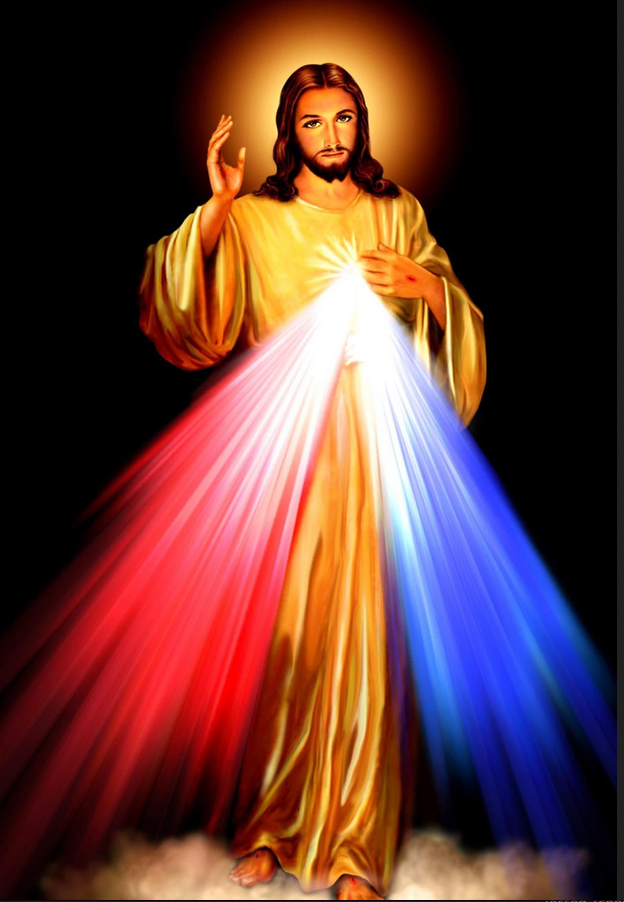
This a near perfect rendition of what Faustina saw in her vision.
Synchronicity = people
April 6, 2026
System Rebuild
For the last few days I have been participating in the Easter activities: Holy Thursday, Good Friday, Easter Sunday, extra observances like the exposition, other sacraments, plus significant prayer and contemplation. With that, many visits with friends with wholesome interactions of deep affection and sharing, it has been a wonderful Easter.
Mixed amongst the busy time of Easter's beginning, I also was forced into a significant upgrade of my computer systems. That was very time-consuming. Not difficult. No costs. Fortunately many of the tasks were made easier by writing overnight automated scripts so I did not have to watch "blue bars" scrolling to the right. I highly recommend that everyone abandon MS Windows, if you can, and suffer the pain of adopting Linux (Mint or Ubuntu) as a base computer system and enjoy the freedom it provides. I never use MS Windows anymore.
I am recovering from nasty cuts on my dominant hand and upper thigh related to a zip-cut disk explosion while using my mini grinder. No infections. The trauma was enough to cause me to rest my hand for a few days (during Easter). The scar will be ugly so now my left index finger will match my right in terms of scars. I am recovering full mobility despite tendon involvement. What was I doing? I was re-installing a section of stairs so that my son-in-law et al. could execute a move of his stored belongings that I had on my second floor. In a week or so, when my hand is sealed up, and the stitches are out, I will continue with the staircase upgrade. I can now type as badly as before the incident.
I don't like War
I don't know what to say about the war. So I will say nothing other than, war kills God's people.
Judicial Reviews
The Judicial Reviews of the 2 past elections in NS are proceeding well. We have a wonderful team. We are awaiting a ruling from Justice Duncan regarding 546552, the by-election review. We are in oral arguments next week for 538503 regarding a Motion from us all on the Sufficiency of the Record, and a Motion to Amend the JR by the AGNS.
Public Interest
I am involved in several matters of importance. They are ongoing.
Contractor Pay Dispute Resolved
Nick Sampson has negotiated a reasonable settlement regarding his pay for a construction job. The client refused to pay him for hundreds of hours of work. I was witness to all of the details. Nick, with the help of Builder's Lien legislation and the Supreme Court of NS, was able to negotiate a settlement with the client's lawyer. Nick will likely never have to contend with such a circumstance again based on his new training.
As a general statement, time and time again, the adage, "No good deed goes unpunished" is true when engaging a certain kind of personality of person. We are called to do good. Often times, the good needed is a consequence of character flaws of the needy person. A person asked Nick for help. That person played-acted like a sweet person, but eventually the true nature manifested. Nick was calm, thoughtful and deliberate, and kind. His kindness, discipline and truthfulness and moral clarity won the day. It took 4½ months to settle.
Development Projects
I am working on some development projects and have made wondrous progress.
A friend had some issues importing an excavator and found a resolution to the complex array of obstacles that stood in the way of him buying the excavator.
The obstacles were in the form of absurd environmental rules, nonuniformity in their application, greased palms, importing consultants, bonded warehousing, Canadian Border Services, logistics companies, foreign sellers, secret side deals, money, mechanics, enforcement and ignorance.
Patience and persistence won the day.
Preparation for the Spring
I want to have my spring activities laid down soon since the warm weather is upon us.
Railings for the concrete steps, the inside stairs steel beam fabrication, the front step upgrade, the starling and raccoon project, the deck, motorcycle tire, wheel bearing of the Camry (new issue).
Theological Considerations
I have a number of ideas that I am dying to write about but the recent issue sidelined all of it. Hang tight.
How often have you witnessed this? The antichrist with the left arm of Lucifer animating his jestures, while whispering in his ear.
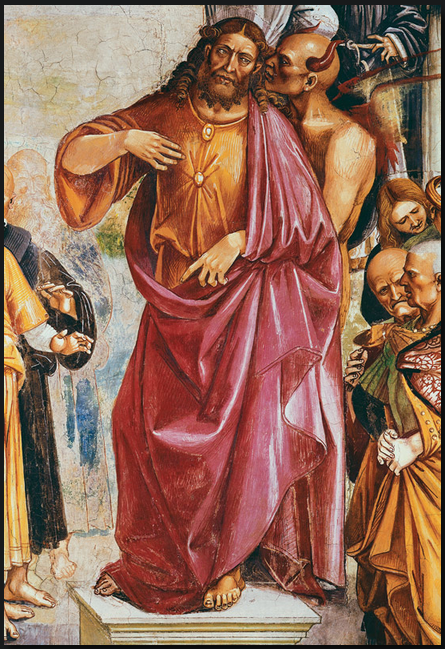
Luca Signorelli's "The Preaching of the Antichrist" in Orvieto.
Ad Astra - King Lear - Grace - Insane Fathers
I watched Ad Astra today for the second time in its entirety, and to me, it was like I was watching King Lear all over again, only this time, the storm was not on a heath but in the black vacuum of space, and the old king was not raging against back-stabbing daughters but against his own unraveling mind, drifting further from Earth, further from sanity, until the son had no choice but to confront him. There was Brad Pitt's Roy McBride, that steady, almost unnervingly constant figure, floating through interviews with psycho-analytic computers probing his mind, asking if he too might be decaying like his father, yet he holds, he endures, he even lets the paternal unbilical cord snap, and in that quiet annihilation, he finds something like peace. It is not vengeance; it is forbearance. It is the necessary suffering, the kind that strips away illusions so you can see the mystery of things, just as Lear does when he tells Cordelia, Come, let's away to prison: We two alone will sing like birds i' th' cage. And take upon's the mystery of things, As if we were God's spies.
And that is precisely what Shakespeare intended, not to punish us with tragedy or preach its inevitability, but to prepare us, to mediate between his own shadowed Catholic soul and ours, so that we might suffer by proxy, empathetically, before THE real blow lands. I remember reading King Lear years ago, feeling the weight of that howl, the eye gouging brutality, the betrayal, yet it was not mere despair; it was a rehearsal. The play demands we face the rot of pride, the decay of power, the innocence crucified by hate, all so that when our own crosses come, whether a mini-grinder's explosion mutilating my hand and thigh, or some deeper familial fracture, we recognize the pattern. We do not collapse; we say, Ah, this is the drama, this is where meaning begins. Because without the affliction, as Malcolm Muggeridge so memorably put it in that 1980 conversation with Bill Buckley on Firing Line, yes, the one I saw when I was eighteen, forty six years back, there would be no play at all.
I recall that Muggeridge told Buckley this little parable: imagine a humane, simple minded old lady, shocked by Lear's torments, storming up to Shakespeare in heaven: What a brutal thing, what a monstrous thing to make that poor old man go through all that! And Shakespeare, calm as ever, replies he could have slipped Lear a sedative after act one, but then, ma'am, there would have been no drama. No prison cell where father and daughter spy on God. Suffering is not pointless; it is the engine of meaning. Life, Muggeridge insisted, is nothing but suffering, and that is why it is worth living. The only thing that ever taught him anything, he said, was affliction, not success, not happiness; it was through pain that reality revealed itself, just like Solzhenitsyn thanking the gulag for the illumination that he would have otherwise missed.
Then Muggeridge turned to The Cloud of Unknowing, that anonymous medieval whisper, and said, when you are aware of the cloud, that vast unknowable at the heart of everything, that is when you begin to know. You acknowledge you know nothing, total humility, total openness, and only then does God appear, much like Meister Eckhart's call to detachment, where the mind stands unmoved by joy or sorrow, resting on absolutely nothing so God might fill it. Faith is not deduction; it is Grace, the animating force, like "falling in love." Buckley pushed back gently, probing: without Grace, how do you cross that void? Muggeridge nodded, Grace is essential, impossible without it, the driving power that turns empty suffering into insight. That one sentence from Buckley stuck with me my whole life: Grace is what makes the impossible possible. It is why my obsession with Grace took root right there, listening to those two men in Sussex 46 years ago.
I love these men.
So here is the redemptive arc: these stories, Shakespeare's embedded mercy, Ad Astra's cosmic quiet, Muggeridge's laugh at drama's necessity, they are not just entertainment. They are mediators, influencing the observer, altering the system. Like Heisenberg's uncertainty: measure you, and you have changed because of it. I read Lear, watched Pitt endure the father's madness, heard Muggeridge explain how suffering births insight, and suddenly my own future collisions feel less inevitable. I approach the insane father in me, or in others, not blind, not proud, but informed. Empathy lets me suffer ahead of time; Grace lets me forbear. The drama speaks to tomorrow so today I can sidestep the full train wreck, because I have already been crucified by proxy, already spied on God from the cage. That is why these artistic/literary works matter: they do not fix life; rather, they equip us to bear it, transformed.
Closing Minute of Equalizer 3
Below is a screenshot of the closing moments of Equalizer 3 with Denzel Washington. A justice-by-violence of a "black knight" movie. Hollywood. Yet, I saw the 2 seconds of the image and simply had to have it. The context is revealed just prior to the fireworks.

Synchronistic Image of Mary backlit by FIREWORKS! - from the movie "Equalizer 3"
Synchronicity =
April 2, 2026
Shroud of Turin
A friend sent me a great video about the Shroud of Turin. A couple of evangelicals hosted Dr. Jeremiah Johnston talking about the shroud and the incredible historical, archaeological, scriptural. and scientific accounts that bear on the image on the Shroud. It is a MUST SEE!.
About my inability to type.... The Plastic Surgeon opted to wait and see. The ERP was cautious in making the referral to plastics but my hand functionality was an indicator of "in tact" tendons. Apparently tendons heal. So, I will put off surgery until recovery levels out and a need becomes apparent, if at all.
I am catching up....
Synchronicity =
March 30, 2026
Crazy Monday-a brief
I haven't been posting much since March 22nd because I had a number of obligations with the Supreme Court of Nova Scotia as well as work, and I got most of that done. However, I injured my right hand and it's a problem because I have no use of my index finger at the moment.
So, in a couple of days, I'm having two tendons in my index finger reattached, and after that, I'll have to convalesce a little bit, but I'm learning to use my left hand for everything. I'll be able to type as normal. I'm not a full-2-hand typist, so it won't be much of a conversion.
My apologies—I'm still here, and I've got plenty to talk about, but my only means to prepare my communications is through typing, and my right hand is useless at the moment.
Synchronicity =
March 22, 2026
Sunday Peace - Coffee - Listening to MP3 Books
I have downloaded a bunch of MP3s from Gutenberg and LibriVox (no digital rights management restrictions). Most of the books are classics, and they form part of a larger effort to build a solid foundation for a comprehensive exploration of my deepest interests: GRACE its nature, its actions, its relationship to created beings, the seraphim, and humanity, especially the individual souls of persons.
It is astonishing how much has been written about GRACE. The scope is vast and profound, shaped by the minds of the witnesses and victims of GRACE. I say victim since the action of GRACE is so abundantly overwhelmingly penetrating to the soul that it is like an assault by total divine love.
God has gifted me with the GRACE of focus and determination. So this Sunday morning, with my coffee and the gentle accompaniment of music, I am reading deeply into the nature of GRACE and the creatures closest to Gods radiance, the seraphim, who sing His unending praise: Holy, Holy, Holy, or as Bishop Barron puts it from Hebrew: Other, Other, Other forever.
Etymology of "Holy, Holy, Holy"
The Hebrew word translated as "holy" in Isaiah 6:3 (where the seraphim proclaim "Holy, holy, holy is the LORD of hosts") is קָדוֹשׁ (qadosh or kadosh), pronounced roughly as "ka-DOSH."
This word appears three times in the verse: קָדוֹשׁ קָדוֹשׁ קָדוֹשׁ (qadosh qadosh qadosh).
The root meaning of qadosh is "set apart," "separate," or "distinct" often conveying the idea of being radically different from the common, ordinary, or profane. In biblical Hebrew, holiness (kedushah) primarily emphasizes separation rather than moral perfection alone; it denotes something or someone who is utterly unique, transcendent, and dedicated exclusively to God.
This sense of "otherness" is why interpreters like Bishop Barron render the triple "holy" as "Other, Other, Other" to highlight God's absolute transcendence and incomparability. God is not merely "better" or "purer" than creation; He is in a category all His own, wholly "other" (distinct from everything created). The threefold repetition intensifies this: it's the supreme expression of God's unparalleled separateness and sacredness.
Synchronicity = astonish
March 20, 2026
What are Seraphim? ...and more on Grace.
I got much of the notes below from newadvent.org. Scroll down for a great union of my 2 favorite words SERAPH and GRACE in Robert Barron's lecture.
From St. Thomas Aquinas's Summa Theologica
Aquinas's Summa Theologica (1265-1274) provides the most systematic Catholic exposition on angels, drawing on Scripture, Aristotle, and Pseudo-Dionysius the Areopagite (5th-6th century). In Prima Pars, Questions 50-64 address angelic nature (pure spirits, incorporeal, with intellect and will), and Question 108 specifically covers hierarchies and orders.
Aquinas adopts Dionysius's nine-choir hierarchy, divided into three levels: the highest (Seraphim, Cherubim, Thrones) contemplates God directly; the middle (Dominations, Virtues, Powers) governs universal causes; the lowest (Principalities, Archangels, Angels) executes particular tasks. Seraphim top this structure as the first order of the highest hierarchy, closest to God.
Name and Etymology: "Seraphim" derives from Hebrew for "burning ones" or "fiery," signifying an "excess of charity" (love). Aquinas compares them to fire's properties: (1) Upward motion—an inflexible, continuous ascent toward God, unhindered by lesser things; (2) Active heat—penetrating sharpness that rouses inferiors to fervor, cleansing them wholly (as in Isaiah's coal); (3) Clarity—inextinguishable inner light that perfectly enlightens others.
Role and Function: Seraphim excel in union with God through love, presiding over the hierarchy. They cleanse, enlighten, and perfect lower angels and humans, acting as instruments of divine providence. In Isaiah, a seraph purifies the prophet's lips, symbolizing removal of sin for prophetic mission. Aquinas notes seraphim's affinity to the Holy Spirit (as Love), but they remain creatures, not divine. They cannot sin post-choice (fixed in good) and operate with superior power over lower orders.
This framework influenced later councils and remains normative, as seen in the CCC's alignment with Thomistic thought.
- aknowlegement to newadvent.org
More on Grace.
Henri de Lubac maintains that Grace is not an extrinsic addition to human nature, but rather the very source of our deepest longing. The innate desire for transcendence, far from being a mere psychological artifact, is, in his view, the initial movement of divine Grace itself. Though his work provoked controversy for seeming to dissolve the distinction between nature and supernature, de Lubac's insight endures: Grace precedes awareness, initiating the soul's ascent before any conscious response is possible.
Karl Rahner describes Grace as a "supernatural existential," an ever-present dimension of human existence. This is not a theological abstraction; it signifies that God's self-communication permeates ordinary life like an ambient light. When perception shifts, when sound acquires color or emotion assumes visible form, it is Grace manifesting in the quiet, unbidden clarity of the moment. Rahner preserves the ontological separation between Creator and creature, yet he renders Grace intimate, as though it were the very medium through which we encounter the world.
Hans Urs von Balthasar conceives of Grace as a dramatic event within salvation history. Rather than a static endowment, it arrives as God's decisive intrusion, unveiling divine splendor, as in the Transfiguration. Beauty intrudes upon the ordinary; motion emerges from stillness. Von Balthasar insists that this intrusion is not coercive: Grace invites rather than compels, offering the soul the freedom to respond, much as one chooses to lean into an accelerating curve while the momentum has already begun.
Yves Congar portrays Grace as the living breath of the Holy Spirit, personal, relational, and communal. It circulates through the Church's liturgy, through shared gestures like the kiss of peace, through the silent solidarity of the assembly. When love becomes perceptible, when minds and bodies converge in mutual illumination, Congar sees the Spirit at work, binding what was divided. Grace, for him, is never solitary; it flows outward, uniting persons in the very act of its own transmission.
Bernard Lonergan examines Grace through the lens of consciousness, likening it to a clarifying light that illuminates the path ahead. It precedes and sustains deliberation without usurping freedom: when sensory boundaries blur, when sound merges with sight or feeling with radiance, Grace elevates perception, granting the soul a steadier view of truth. Lonergan maintains that this elevation is preparatory, not determinative; the decision to act remains the individual's own.
Catherine of Siena dispenses with elaborate systems in favor of direct encounter. She writes that God draws the soul precisely because it loves, and in that drawing lies Grace's essence: a burning coal upon the tongue, a lingering perfume, a visible flame of beauty. Music becomes motion; passion glows as light. Catherine offers no treatise, only the raw, unmediated reality of divine touch: Grace as kiss, as fire, as the inexorable return to home.
Barron on SERAPHIM and a breakthrough of GRACE - Isaiah 6:1-8
Let the Grace take hold of you. Listen how he stresses its importance.
Synchronicity = break through
March 17, 2026
Happy Saint Patrick's Day
I am dreaming of Corned Beef and Cabbage
Not good for me at the moment so I have to pass. But I can dream.

Little Trinity Model & 17 = Q :)
Puppet to the Whims of Balloons
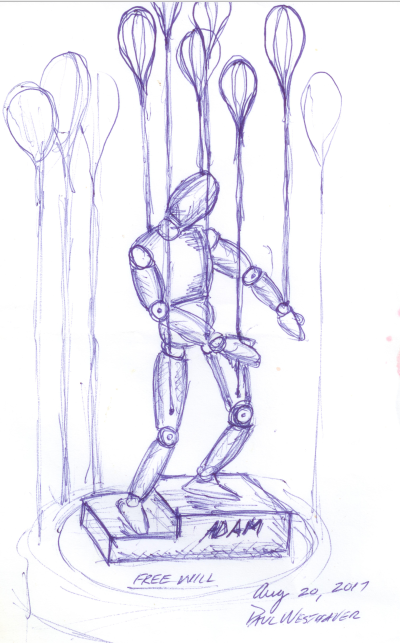
Synchronicity = work
March 15, 2026
Sunday Peace - Quiet - Coffee - Belle Heaulmiere
I had a vistor today and I played some Stan Rogers' tunes. Lies is a beautiful song and poem by Stan. This aligns with the previous post regarding nakedness in heaven in this way: We are called to look at one another not with our eyes but with our hearts. God does not look at us with His eyes. He looks at us with His heart.
Stan's poetry is complete in this following song. A woman laments the loss of her beauty as she saw herself aged in a mirror. Resolved as she experiences agape love from her husband. The love that is agape love, that sees the heart.
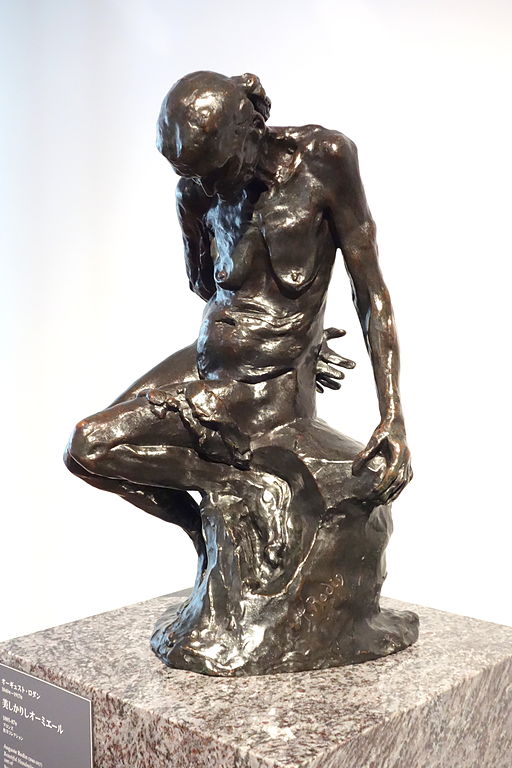
Auguste Rodin's Belle Heaulmiere
If you listen closely to Stan Rogers' "Lies," you hear a quiet story unfold about a woman who stands before her mirror one morning, tracing the lines that time has etched across her face. She remembers herself as beautiful, lithe, the kind of woman who turned heads at dances but now the years have left their mark: a ranch wife's hands roughened by work, shoulders bent from carrying children and chores, eyes that no longer sparkle with the same easy light. Yet the song never lingers in pity. Instead, Rogers lets her husband speak, soft, reassuring and steady, saying those age tracks are nothing but lies. Beauty, he insists, has not gone anywhere; it is just seen with her lover's holy eyes. ( 1 Samuel 16:7 "Man looks at the outward appearance, but the Lord looks at the heart" - today's reading.)
And then, almost like a gentle aside, the lyrics brush against Auguste Rodin's sculpture of the Belle Heaulmière, the old helmet maker's wife. Rodin carved her without affectation: skin loose and folded, spine curved, breasts fallen, every ridge and hollow a testament to what youth once promised and age has taken. She stands there, frozen in bronze, a woman who once sang of her own lost charms in Villon's poem fair hair, firm thighs, laughter that rang through Paris streets now reduced to this weathered shell.
What Rogers does, though, is borrow her image not to mourn, but to redeem. His ranch wife sees the same ruin in the glass, yet she turns away from it. She sets the mirror down, pours coffee, smiles at her man across the table. The sculpture's truth decay, inevitability meets the song's quiet defiance: love does not care what the mirror says. Rodin's sculpture is missing her beloved companion. The ranch wife's husband sees the girl still inside, the one who danced barefoot on summer grass.
Together they form something tender: Rodin's lonely bronze woman, all honest wreckage, and Rogers' voice, warm as a woodstove, telling us beauty is not an ephemeral surface beheld. It is the stubborn way we keep loving each other through the lie of time.
"But the Lord said to Samuel, 'Do not look on his appearance or on the height of his stature... for the Lord sees not as man sees: man looks on the outward appearance, but the Lord looks on the heart.'" (1 Samuel 16:7)
and - "The eye through which I see God is the same eye through which God sees me; my eye and God's eye are one eye, one seeing, one knowing, one love." — Meister Eckhart
The conclusion of Sunday’s Gospel.
Some of the Pharisees near him heard this, and they said to him, “Are we also blind?” Jesus said to them, “If you were blind, you would have no guilt; but now that you say, ‘We see,’ your guilt remains.
Deacon Len Moore
Yes Len, that closing exchange from John's Gospel (John 9:40–41) lands like a quiet rim-shot, especially on this Fourth Sunday of Lent (March 15, 2026, in the liturgical calendar). It's the sharp, sobering conclusion to the long narrative of the man born blind, where Jesus has just healed him, sparked controversy, and drawn out layers of spiritual sight and blindness.
Synchronicity = [1 Samuel 16:7] + Eckhart's eye = AMAZING!
March 13, 2026
Finally Got To Do Catch-up
I have been so busy I let an awful lot simply slide. I have 100s of digital media flash cards and USBs and many of them were corrupted. Since I run a linux platform I was able to access some pretty amazing tools. I was able to recover 100% of the flash and USB drive media. Thousands of photos and movies. I will transfer them to this server for controlled access for those of you who may want them... let me know.
I took this picture 6 years ago. This beautiful lady hung around for 3 days in August 2020. I saw it.

She stayed with me for 3 days.

Planning this assembly was tricky.
Synchronicity =
March 12, 2026
The Westhaver Law
What each term means:
- R* — average rate of star formation in the galaxy (stars per year)
- fp — fraction of those stars with planets
- ne — average number of habitable-zone planets per star
- fl — fraction of those planets where life emerges
- fi — fraction where life becomes intelligent
- fc — fraction of intelligent life that develops detectable technology
- L — average lifetime of such civilizations (years)
- fk1, fk2, fk3, …, fkn — factors yet unknown, but must exist, because the only evidence we have is there is only one "1" intelligent civilization: EARTH
The implication? Every single term must multiply out to exactly 1. Otherwise, we’d see more intelligent civilizations than just Earth. No speculation. Just math. Sorry Frank. Observations do not support your speculation.
For comparison: The now obsolete Drake Equation
N = number of intelligent civilizations
The Westhaver Law version starts here… but then keeps multiplying until it N=1.
Synchronicity =
March 11, 2026
Click That button - It Feels Good
Synchronicity =
March 9, 2026
Do We Wear Clothes in Heaven?
A friend and I were discussing concupiscence, the fall, and how we must view our loved ones, and our enemies. We considered the making of Man and Woman. The new Eve, and the absence of marriage in heaven.

Adam and Eve after Adam awakens to the end of his solitude in the form of God's finale to creation.
Clothes and Cloths and Cathedrals in Heaven
I don't think that any exist in heaven. The Catholic Church is conspicuously quiet on this. The question fades when we see what the Church holds as true.
First, from Yeats:
Had I the heavens' embroidered cloths,
enwrought with golden and silver light,
the blue and the dim and the dark cloths
of night and light and the half-light,
I would spread them under your feet.
But I, being poor, have only my dreams;
I have spread my dreams under your feet;
Tread softly because you tread on my dreams.
Yeats looks at beauty and thinks it needs a beautiful gift. Aware of some of his limitations he imagines heaven's own silk, golden, silver, half-lit, and lays it down at the feet of the woman of his desire, like a man who believes the body, even perfected, might still want for something. His poverty is honest. Even his poetry projecting his desires fall short of agape love and looks past his own stated limitation, his poverty of spirit, and he stops at his own dreams, as Helen Vendler observes, he remains at the foot of that ladder of ascent from physical to spiritual, because he cannot yet climb (Our Secret Discipline, p. 128). He sees radiance, yet thinks it must be acknkowleged, woven, offered, borrowed from above and judged with his imperfect eyes. He is aware of his dreams, yet he offers them conditionally to his beloved.
Aquinas is more specific and noticeably he does not write to the vaguries. The glorified body is not improved by cloth. It is already complete. Soul and flesh unite so perfectly that the skin holds its own light, impassible, subtle, agile, clear (see Summa Theologica, Supplement, Q. 82, a. 1; Q. 85, a. 1–3). A body passes through walls, as Christ's did (John 20:19); how could it, if cloth, or some other artifact of the human mind still bound it? Further, the radiance is not a gift laid at the feet. It is the body itself, restored to what God first spoke: whole, alive, glorified, perfect, as the Catechism teaches, "the risen body will be free from all defects" (CCC 999), and "clothed with immortality" (1 Cor 15:53), yet without any need for earthly coverings.
Eve knew this gaze. Adam saw the completion of God's creation not as flesh to augment, but as God's poem, spoken perfectly. Absent of the concupiscent distortion. Mary, immaculate from conception, embodied that poem and held God inside her as she, the tabernacle of flesh, nourished the Word. Cathedrals rise in her image: stone and gold, blue glass at Chartres, arches soaring over centuries of artistic toil. Thousands of hands, artists, artisans, dreamers, pouring genius into light and sound and scent, trying to frame heaven's essence. They build what Yeats wove: an approximation, a tender reach toward glory. Clothing for the Eucharist. Yet Aquinas simply states what they labor to suggest. That the body, perfected, needs no frame at all. It needs no clothes. It needs no veil. The very idea of nakedness never enters the mind of Adam. He did not know what naked meant.
We catch glimpses here in our distorted reality. A face lined by years, yet steady with quiet fire. A hint of the divine blinks through. A presence that calms without speaking. The soul's flame flickering through. Self-evident, subtle, a tiny outline of what is finished in heaven. A hint that the body, even now, can radiate without masking with clumsy accutriments. True beauty is never something we apply to creation. It is what remains when the costume falls away. (Hat tip to Meister Eckhart)
We adorn ourselves in clothes. We dress each other in our dreams. Here in this world. In heaven we will only see beauty, truth and goodness. If the cloths of heaven are woven by the hand of God, and wrapped around me by His hands, then I say my own skin, glorified, is Heaven's Embroidered Cloth.
Postscript: There is more to be said about this poem at another time.
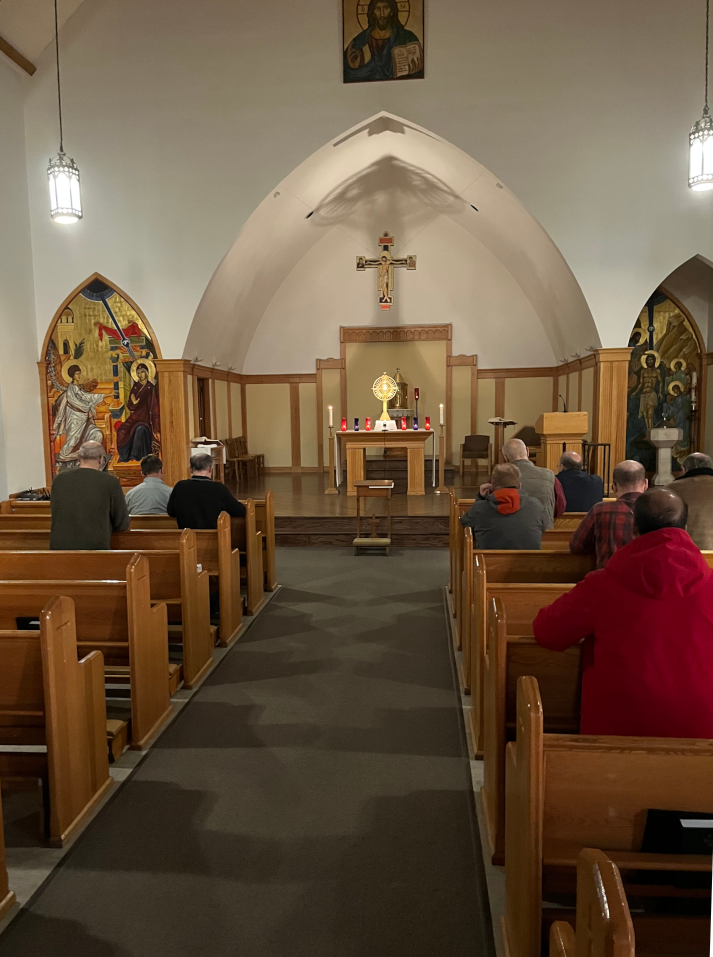
Men in prayer at Saint Catherines Church. I miss Kevin.
Synchronicity =
March 8, 2026
Sunday Peace - Polyeleos
Today's Gospel is John 4: 5-42
This a great reading and so dense that I can't do it justice and I do not want to abbreviate it with a quote from Jesus because the whole image is lost in attempting to make a short quip.
I think it requires contemplation. I am not looking up interpretations at this point since I am already flooded with impressions and I choose not to truncate them just yet.
Read it for yourself. It is worth it. Jesus declares to a woman that he is the Messiah. Imagine that.
Synchronicity =
March 7, 2026
Getting an Idea Out
Isaiah showered with Grace of God Isaiah 6: 1-8
What must have the been like?
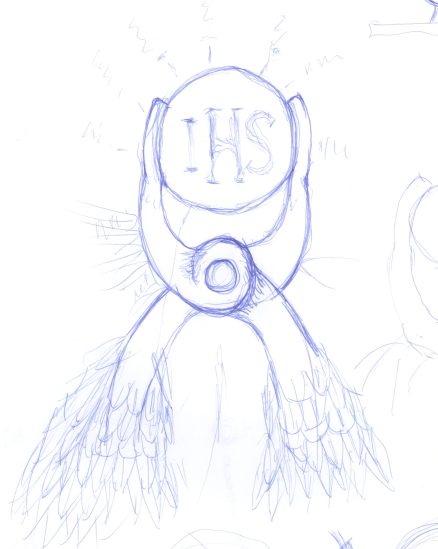
I saw the connection long ago...
Synchronicity =
March 6, 2026
Good Morning
I love you. It is 5:30 am and I am going to FM645 in a couple of minutes and I wanted to be in the right frame of mind. A lenten Friday.
I am packing my bags for my trip to hell... bringing a life-long supply of Grace, and meeting my friend Virgil when I get there.
Synchronicity =
March 5, 2026
Paradise Lost by John Milton
I am working on a piece that examines the popularity of the poem Paradise Lost around the time of the American Revolution and the formulation of the American Experiment. I would say all of the founding fathers were quite taken by the poem and maybe Jefferson the most. E Michael Jones inoculated me with the idea first. The idea that, at it's core the USA was created by men intoxicated with hubris and the sophomoric momentum of their self adulation validated by Milton's Lucifer.
The American Revolution was not born in the quiet of Enlightenment salons, but in the fevered reading of John Milton's Paradise Lost. Milton, a blind Puritan poet, composed an epic not to glorify rebellion, but to justify the ways of God to man. Yet his portrait of Satan as charismatic, wounded, and defiant proved too luminous for young men already restless under monarchy. In Book 1 (one), the fallen angel, scorched and unbowed, declares: "The mind is its own place, and in itself / Can make a Heav'n of Hell, a Hell of Heav'n... Better to reign in Hell, than serve in Heav'n." These lines, intended as tragedy, became scripture for a generation that mistook defiance for destiny. You men have not changed.
Thomas Jefferson, at thirty-three, and his contemporaries, Adams, Franklin, and Paine, were not scholars of theology. They were revolutionaries in their prime, minds alight with the promise of self-rule. When they read Milton, they heard not warning, but invitation: the serpent's whisper from Eden, "Ye shall be as gods," refracted through Satan's voice. The poem's tragedy, the slow unraveling of pride, and the golden Pandemonium built on ash, was lost. They took only the first act: the declaration of independence from authority, the refusal to serve.
Paine, in Common Sense, made the echo explicit. He wrote of monarchy as "a pestilence," then borrowed Milton's cadence to sharpen his pen: "Men who look upon themselves born to reign, and others to obey, soon grow insolent; selected from the rest of mankind their minds are early poisoned by importance... and the world is given to them to prey upon." The phrase "poisoned by importance" recalls Satan's own self-deception, his belief that sovereignty over Hell could substitute for Heaven. Paine did not name Milton, but the rhythm betrays him: rebellion as virtue, hierarchy as sin. The Declaration of Independence followed suit: "When in the Course of human events, it becomes necessary for one people to dissolve the political bands which have connected them with another... they are endowed by their Creator with certain unalienable Rights." The Creator is invoked, yet the rights are claimed by men as self-evident, self-declared, self-sovereign.
The Sovereign Self. Now there is a profane utterance in common parlance today amongst fools with superiority complexes.
Milton's intent was the opposite. He wrote to expose the illusion: Satan, once brightest of angels, ends chained by his own mind. "Which way I fly is Hell; myself am Hell," he confesses. The poem is no hymn to autonomy. It is a requiem for it. Paradise is lost not because of tyranny, but because pride mistakes freedom for godhood. The Founders, in their youth and ambition, heard only the clarion call. They built a nation on the premise that man could author truth without themselves bowing to it. The result was not Eden, but a republic haunted by its own hubris: slavery inscribed in law, killing children, wars waged against "liberty" in its name, that looked suspiciously like conquest. Vanity. All is vanity.
Milton offers no easy redemption, but he does point to one: after the fall, Adam and Eve weep, then rise, humbled, dependent, restored through grace. "Some natural tears they dropped, but wiped them soon." That quiet return, not the roar of revolt, is the true path. The American experiment skipped it. We began with Satan's line and never looked back. The serpent still whispers: you can be as gods. And we still listen.
... a diversion that fits ...
As I was researching this, a strange synchronicity struck: a Discovery Channel documentary drifted across my screen, tracing Lady Liberty in New York Harbor back to her Roman roots. It felt fitting, almost inevitable, that she should close this circle.
The Statue of Liberty rises in the harbor, torch aloft, a verdant promise against the gray Atlantic. Yet at her feet lies a broken chain, not ornamental but deliberate: Frédéric Bartholdi placed it there to signify emancipation. The links are severed, yes, but not dissolved. They dangle, half-forgotten, a quiet indictment. Liberty does not obliterate bondage; it redistributes it. For every soul set free, another is left in shadow. And the arbiter? Always the one who holds the flame.
She is Roman through and through: Libertas, goddess of the republic, clad in white, cap of liberty in hand, scepter of authority raised. She presided over a city that boasted freedom while chaining its provinces and enslaving its captives. Her Hellenic kin, Eleutheria, danced closer to the wild: she was Dionysus's shadow, goddess of release, of ecstasy unbound. In Euripides' Bacchae, Dionysus arrives not as liberator but as tempter. He lures Pentheus, Thebes' proud king, into madness; the monarch, spying on the maenads' rites, is torn limb from limb by women drunk on divine fury. His own mother, Agave, severs his head, mistaking it for a lion's. This is freedom stripped bare: feral, blood-soaked, without mercy. Dionysus stands apart, amused. Thebes collapses into ash.
E. Michael Jones names it Dionysus Rising: the pagan heartbeat beneath the modern age. Liberty is no mild virtue; it is rapture. It cries, Shatter every yoke, then steps aside as the fragments rain down. The Founders adored her. They etched her likeness on seals, wove her cadence into pamphlets, enshrined her in law. Yet they never glimpsed the chain or the carnage. They imagined liberty as mere absence of kings, echoing Satan's defiant cry: I will not serve. Milton, wiser, understood: such liberty is the prelude to perdition. The chain at her foot? It was never truly broken. It was merely passed on, to us, to the world. We brandish the torch, but our ankles still chafe. And Dionysus? He has not whispered. He has risen. Lady Liberty now dances in the woods, profane and unashamed, her torch guttering in the dark.
We are now bearing witness to a profane reality born of adolescent-like hubris. Paradise is lost and no human exhortation can rebuild it.
The american revolution, this act of pride or hubris par excellence, triggers catastrophic downfall:shame, expulsion from paradise, curses on childbirth, toil, and mortality, and the introduction of sin and death into the world. What begins as a compulsive grasp for godlike status ends in humanity's profound loss of innocence and communion with God. It is at play in theses days. War. We are, again, at war.
The serpent's evil plan succeeds precisely because it exploits this latent human arrogance, mirroring his own prior fall through pride. Echoed in Isaiah 14 and Ezekiel 28. The result is the archetypal self-inflicted ruin: overconfidence in defying the ultimate authority, orchestrated by cunning malice, leading to eternal consequences for all humanity.
HOPE?
The poem's conclusion in Book 12 offers a poignant counterpoint to the tragedy of the Fall: after the expulsion from Eden, GRACE emerges as the path to restoration, but only through genuine humility, repentance, and dependence on divine mercy rather than self-reliant pride.
The expulsion itself is the emotional climax. Michael leads them to Eden's eastern gate, where cherubim stand guard with a flaming sword. As they look back:
With dreadful Faces throng’d and fierie Armes: Som natural tears they drop’d, but wip’d them soon; The World was all before them, where to choose Thir place of rest, and Providence thir guide: They hand in hand with wandring steps and slow, Through Eden took thir solitarie way.
OOOPS - I went too far... :)

Synchronicity = liberty, grace
March 2, 2026
Physics of the Mind - The Edge of Knowing - The Vortex
I was listening to a TED talk by Anil Seth and that led me to find Mike Weist. In the video below he is a guest of John Clippinger who is less interesting. So I attached the video here below and skip to the meat of the matter which is very well explained by Mike Weist at about 10 minutes in and runs for about 6 minutes.
The subject matter is Microtubules, Conciousness, the necessity of quantum (non-localized) participation in the actualizition of a frame of awareness. An inordinate amount of "synchronicity", for want of a better word, "Grace" maybe?....piled up ahead of this exposure to Weist's thinking.
My interest in this is as a theological policemen. Not as a judge since I do not know enough to act as a judge. I have a sense of intrusion of ancient occult thinking on the fringes of this subject and I have great confidence that God's Universe is rationally intelligible with that very weirdness that the "alchemists" are advancing in the interest of the pagan presumptions. With that, Augustine and Aquinas has dealt with this collision soundly. See Hermeticism.
To my family of Catholics who hear unsettling words: my assumption is that Our Faith is rich in teaching on these similar subjects. I am openly engaging to teach myself how to deal with ORCH OR and the wave of interest on this subject. The serpent is always first to the fight. I am in training.
I give you Weist on Consciousness - Lean on CCC
Synchronicity = institute, photo of ??
March 1, 2026
Sunday Peace - Contemplative Time and Time to Think.
Writing a huge report today. No excitement.
Just the familiar visits. ;) <3
The Transfiguration is Grace to the Max!!
Re: Matthew 17:1-9 -- I have some thoughts on this....
Today's gospel stands out as remarkable. It describes the Transfiguration, where Jesus ascends the mountain accompanied by Peter, James, and John. There, his face radiates like the sun, and his garments become dazzling white as light.
That brilliance represents some evidence of the inherent nature of God, unfiltered and luminous. Adam and Eve would have encountered such glory every day in Eden, in comfort, without astonishment. It simply belonged to them. But the Fall of man destroyed our self-perception and our perception of God. Our understanding became perverse and small.
After his resurrection, Jesus returns and mingles among people, sharing meals and revealing wounds. Then on Tabor he reveals his ccompleteness. Not because he altered himself, but because the barrier dissolved. This moment offers a glimpse of how we shall eventually behold him. This moment reveals,maybe, how, we too, shall appear.
Grace operates as an active force, not a passive possession. God wills the good, enacts the good, and infuses it into our existence. On that summit, Grace manifested itself plainly. It removed the veil of the ordinary and permitted divine splendor to flood through. The disciples' astonishment matters, but less than the radiance, the persistence of Grace itself.
Meister Eckhart urges detachment from worldly distractions, silence of the mind, liberation from that which is not God. In that stillness-in-ecstasy, one perceives God perceiving oneself, a single unbroken vision. Aquinas explains that Grace preserves our humanity while elevating it toward divinity. Forgiveness removes obstacles. Detachment widens the pathway. Both contribute and seem to be at play in this mystical event.
The Transfiguration hints that our glorified bodies remain our own flesh, not a substitute, but transform as well. It endures resurrection, freed from suffering, mortality, and every trace of original sin. Radiance becomes its essence, mirroring Christ's appearance on the mountain. Perhaps Adam and Eve possessed such bodies from creation, perfectly formed by God, already saturated with grace. The Transfiguration did not instantiate this state. It was like going home, so to speak. It recalled our ancestral heritage in paradise. And it foretold what awaits us after death: bodies restored, perfected, participating in the divine life through Grace.
Grace weaves through everything. It consists in willing, in acting, in illuminating. It does not merely describe the mystery. It embodies the mystery. God's presence descends upon the mountain, upon the cross, upon our daily struggles. One day, when the veil finally lifts, we shall enter that light anew. Not as visitors. As ourselves, restored and complete.
POST SCRIPT - Dietrich von Hildebrand
Having long known Dietrich von Hildebrand's writings and heard Alice speak of them many times, I recently felt drawn back to his Transformation in Christ. There, Grace emerges as the very engine of transfiguration: not supplanting our nature but building upon and radiantizing it, calling forth an unconditional readiness to change so that we may become new in Christ. This resonates deeply with the mountain moment, Grace dissolving barriers, unveiling divine splendor, and hinting at our own restored, participating flesh. It affirms that what shone on Tabor is no distant ideal but the promise of Grace at work in us, drawing us home to that luminous completeness. I will revisit von Hildebrande.
Synchronicity = body, world, ideas, synchronization, WHOA NELLIE!!!!
Something wild happened in writing this piece--- way to much overlap and literal synchronicity
February 28, 2026
A Visitors Are Welcome.
Had a Great Time Doing Brakes Today. God's Work eh?
God worked on me today. He allowed me to help a friend get his brakes done.
I played Polyeleos and "Hitch" a Ride". We worked hard together and got it done. Nobody got hurt.
Synchronicity =
February 26, 2026
Imagine a Great Good.... if you can...
Is it possible that a great good is at work and that great good is not apparent to you? This kind of thing happens all the time.
Illumination from the vestible, pipe organ in the loft, and "Peace be with you Paul" from an angel. That would be fantastic!
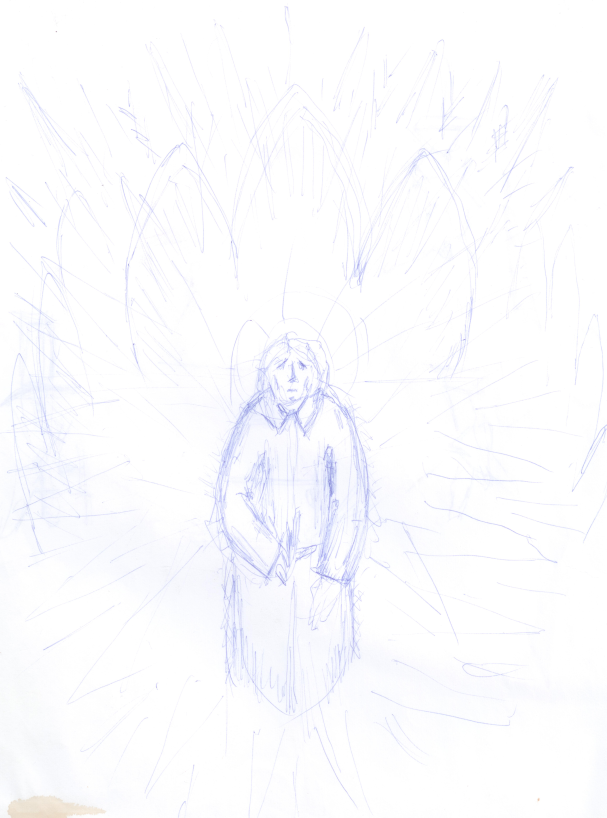
I drew it way back when it happened...1987?
Synchronicity = work
February 24, 2026
Grace and Sacrifice
My life long examination into the Nature of Grace got another contribution this past couple of weeks. I have been studying the sermons of Meister Eckhart as you can see below in the thread of this blog. When I changed the website from a one-way communications hub to a list of my interests, I set up a bunch of pages one of which was "Grace". I have been interested in the subject for 46 years and my recent interest in Eckhart has opened up a whole new perspective. William F. Buckley planted the simple question. Now I find the answer far more difficult. Eckhart is difficult. But, I think I am getting it. Here below are my initial thoughts on Grace informed by Eckhart, with a long foundation from Aquinas. Additionally, I seem to consumed by a great need to pour my life into needy souls. Sacrifice. So you may detect a perversion of Eckhart from me since I am in rebellion with his presupposition that forgiveness is unnecessary in view of his drive towards detachment as a means to holiness. You can find these thoughts on the webpage GRACE. This blog post is considated on that page. Please criticize me.
What is the Nature of Grace?
I have spent decades turning this question over in my mind, and the more I read Aquinas and now Eckhart, the more I realize the question itself is part of the Grace. I am better simply because of attending to the subject. It never quite settles. It keeps returning, like a hand that won't let go during the kiss of peace, like a name spoken once that echoes for forty years. Aquinas gives us structure; Eckhart gives us fire. Neither feels complete on its own, but together they point toward something I can only call the act of Grace itself.
NOTE: The bolded terms are usages from Aquinas and Eckhart
Saint Thomas Aquinas approaches Grace with the care of a master builder. He insists Grace is created, a supernatural quality, a "habit" that God infuses into the soul the way dye changes cloth without becoming the cloth. Sanctifying grace is the permanent change that makes the soul pleasing to God and lifts human nature into participation in divine life. Actual grace is more fleeting; it prompts specific acts of will or intellect (prayer, forgiveness, the decision to rise when everything says stay down). Then he draws further distinctions: operating grace is God moving first, without any initiative from us; cooperating grace is the moment we join that movement, our will folding into His. Prevenient grace comes before we even desire the good, preparing the soil; subsequent grace follows and sustains the good once it has begun. And through it all he is scrupulous about one thing: Grace remains distinct from God. Creator and creature stay separate. He is protecting something essential, the real difference between God and us, so we do not slip into thinking we are divine.
That careful architecture is admirable, even comforting. Yet it can feel mechanical. Grace begins to look like a tool God employs rather than the action of the touch of His own hand. The many categories (sanctifying, actual, operating, cooperating, prevenient, subsequent) cover every angle, but in doing so they risk turning love into a formula, a system we can diagram instead of a presence we can only experiamce.
Meister Eckhart takes the opposite road, and it is both exhilarating and unnerving. For him Grace is not created at all; it is God, the very ground of being. There is no habit to be added, no layer to be laid on top of the soul. When Grace arrives, the soul does not receive something from God; it merges into the divine essence. All separation (ego, sin, the noisy world) dissolves in His presence. Grace is oneness, not something given but something realized: the soul becomes what God is. The risk is obvious. The Church has always called this edge-heresy because it blurs the line between Creator and creature so completely that the human person seems to vanish. Eckhart suffered excommunication for a while. Yet when you read Eckhart, you feel the pull of something true. The language loops back on itself (Grace is God, God is Grace), and the repetition is almost painful, like staring into a mirror that reflects only moving light. It is overwhelming. And that overwhelming quality feels closer to the moments I have known than any category ever could teach.
So where does that leave us? Somewhere between Aquinas's careful distance and Eckhart's wild oneness. Grace is God acting, willing the good, then making it real, without turning into a separate substance or erasing the one who receives it. It is not a created habit, not a gift handed over, but the very motion of divine love reaching into time and flesh. It touches soul, mind, and body together, remaking without replacing, clarifying without overwhelming. And it is never separate from God: it is His motion, His love, His presence moving through us.
To clarify, the Holy Spirit is the breath and fire of that motion, the Third Person of the Trinity, the personal love between Father and Son. He has will, He speaks, He intercedes with groans too deep for words. He is not an impersonal force; He chooses to love me. When He acts, Grace happens.
The soul is created, immortal, rational, the image of God that animates the body, giving it life, motion, heartbeat. It receives God's act and is remade, never replaced. It knows, it loves, it chooses.
The mind is simply the knowing faculty of the soul, how it sees truth, judges, remembers. Grace does not give it a new intelligence; it brings clarity, the sudden sense that what was hidden is now plain.
And Grace itself, our landing after all the reading and wrestling, is God, willing good and then doing it. The reach. The eternal touch. The burning lips of Isaiah. My burning tongue. It strikes soul, mind, and body at once. It never stands apart from God; it is His motion, His love, His presence breaking into our ordinary hours.
That is as close as I can come for now. The categories help, but they are just scaffolding. The reality is that hand that forever held mine in church forty years ago in Saint Mary's Bascilica, the coal that touched Isaiah's lips, the special name spoken in my home, the lingering smell of my mother's perfume. Grace is not a definition we recite. It is the verb by which we are mastered by love.
Synchronicity =
February 22, 2026
SUNDAY PEACE - Coffee- Quiet - Beauty
Today's Readings
...wonderful...
Genesis 2:7-9; 3:1-7 - The Fall
Psalms 51:3-6, 12-13, 17 Miserere Mei
Romans 5:12-19 Sin through Adam, Grace through Christ
GOSPEL Matthew 4:1-11 Temptation in the Desert
Here are some thoughts on the liturgy of the Word today...hinging on Meister Eckhart.
First Reading - The Fall of Man:
Eckhart commented extensively on Genesis 1–3, viewing it philosophically and mystically. He saw Adam and Eve's story not primarily as historical guilt but as illustrating the soul's turn from divine unity to multiplicity and attachment. The "knowledge of good and evil" represents the fall into dualistic thinking, separating self from God, clinging to creatures instead of resting in divine being.
The serpent's temptation symbolizes the pull toward self-will and possession, leading to a false "nothingness" apart from God (creatures are "pure nothings" without Him). Yet Eckhart often reframed the Fall as part of a necessary journey: detachment reverses it, allowing the soul to return to its uncreated ground where God births the Son eternally in us. Sin arises from attachment; Grace restores unity.
He didn't dwell on inherited guilt in a juridical sense but on how the soul's refusal of God creates illusion. The "breath of life" (Genesis 2:7) points to the divine spark in the soul, untouched by the Fall, where God and soul are one.
Psalms 51:3-6, 12-13, 17 Miserere Mei
1 Miserere mei, Deus, secundum magnam misericordiam tuam; et secundum multitudinem miserationum tuarum, dele iniquitatem meam.
Have mercy upon me, O God, after thy great goodness: according to the multitude of thy mercies do away mine offences.
2 Amplius lava me ab iniquitate mea: et a peccato meo munda me.
Wash me throughly from my wickedness: and cleanse me from my sin.
3 Quoniam iniquitatem meam ego cognosco, et peccatum meum contra me est semper.
For I acknowledge my faults: and my sin is ever before me.
4 Tibi soli peccavi, et malum coram te feci; ut justificeris in sermonibus tuis, et vincas cum judicaris.
Against thee only have I sinned, and done this evil in thy sight: that thou mightest be justified in thy saying, and clear when thou art judged.
5 Ecce enim in iniquitatibus conceptus sum: et in peccatis concepit me mater mea.
Behold, I was shapen in wickedness: and in sin hath my mother conceived me.
6 Ecce enim veritatem dilexisti; incerta et occulta sapientiae tuae manifestasti mihi.
But lo, thou requirest truth in the inward parts: and shalt make me to understand wisdom secretly.
7 Asperges me hyssopo, et mundabor; lavabis me, et super nivem dealbabor.
Thou shalt purge me with hyssop, and I shall be clean: thou shalt wash me, and I shall be whiter than snow.
8 Auditui meo dabis gaudium et laetitiam: et exsultabunt ossa humiliata.
Thou shalt make me hear of joy and gladness: that the bones which thou hast broken may rejoice.
9 Averte faciem tuam a peccatis meis, et omnes iniquitates meas dele.
Turn thy face from my sins: and put out all my misdeeds.
10 Cor mundum crea in me, Deus, et spiritum rectum innova in visceribus meis.
Make me a clean heart, O God: and renew a right spirit within me.
11 Ne projicias me a facie tua, et spiritum sanctum tuum ne auferas a me.
Cast me not away from thy presence: and take not thy holy Spirit from me.
12 Redde mihi laetitiam salutaris tui, et spiritu principali confirma me.
O give me the comfort of thy help again: and stablish me with thy free Spirit.
13 Docebo iniquos vias tuas, et impii ad te convertentur.
Then shall I teach thy ways unto the wicked: and sinners shall be converted unto thee.
14 Libera me de sanguinibus, Deus, Deus salutis meae, et exsultabit lingua mea justitiam tuam.
Deliver me from blood-guiltiness, O God, thou that art the God of my health: and my tongue shall sing of thy righteousness.
15 Domine, labia mea aperies, et os meum annuntiabit laudem tuam.
Thou shalt open my lips, O Lord: and my mouth shall shew thy praise.
16 Quoniam si voluisses sacrificium, dedissem utique; holocaustis non delectaberis.
For thou desirest no sacrifice, else would I give it thee: but thou delightest not in burnt-offerings.
17 Sacrificium Deo spiritus contribulatus; cor contritum et humiliatum, Deus, non despicies.
The sacrifice of God is a troubled spirit: a broken and contrite heart, O God, shalt thou not despise.
18 Benigne fac, Domine, in bona voluntate tua Sion, ut aedificentur muri Jerusalem.
O be favourable and gracious unto Sion: build thou the walls of Jerusalem.
19 Tunc acceptabis sacrificium justitiae, oblationes et holocausta; tunc imponent super altare tuum vitulos.
Then shalt thou be pleased with the sacrifice of righteousness, with the burnt-offerings and oblations: then shall they offer young bullocks upon thine altar.
Second Reading - Sin through Adam, Grace through Christ:
Eckhart engaged Saint Paul's' contrasts of Adam/Christ indirectly through Grace, sin, and divine birth. He stressed Grace as God's self-gift, making the soul "like God" and buoyant toward divine works. Sin (from Adam) is a "death of Grace," a weakening that separates us from God's flow.
But Grace abounds more: Christ restores what Adam lost, not by erasing sin's effects externally but by birthing divine life in the soul.
Eckhart saw this as ontological. Grace isn't added reward but union with God's being. The soul, detached, receives this superabundant Grace, overcoming sin's "reign" in death.
GOSPEL Matthew 4:1-11 Temptation in the Desert
Eckhart didn't have a dedicated sermon on this passage, but it fits his mysticism perfectly.
Overall, Eckhart would likely read these readings as one arc: the Fall shows attachment's illusion; the psalm cries for inner renewal; Romans contrasts death-dealing separation with life-giving union in Christ; and the Gospel shows detachment's triumph in the desert. The goal? Not moral perfection alone, but sinking into the soul's ground where God and soul are one, beyond sin's shadow, in Grace's light.
EARLY ANNOUNCEMENT

Independent Candidate Julissa Stewart - Congratulations Julissa!
Synchronicity =
February 21, 2026
SATURDAY MORNING! - Breathing again!
Time for Big Zoom Call I suppose..
I am back to matters of the day and more routine concerns. My office needs some tender loving and care. YIKES!
Back to Work.
I was working of a serious project and was delayed by obligations to the Supreme Courts. Now that those matters are dealt with.
Here is a cool thing
First Speculum / Anal Retractor
The Sun King’s Anal Fistula: A 17th-Century First-in-Human Trial (With Zero IRB Approval)
Versailles, 1686. Louis XIV, absolute monarch, gourmet, and serial womanizer, develops a perianal abscess that fistulizes into a classic fistula-in-ano. Painful, foul, and frankly undignified for a guy who invented ballet.
Enter Félix de Tassy, royal barber-surgeon (because razors are basically scalpels with better marketing).
After seventy-five practice patients, mostly coerced peasants, he unveils his prototype: a three-pronged iron retractor, expandable like a medieval speculum on steroids; a sickle-shaped, razor-sharp scalpel with a probing tip, perfect for blind fistulotomy; and gold-thread sutures, because why not add bling to infection control.
No anesthesia, no antibiotics, just hot irons, a stiff drink, and Louis lying there like it was Tuesday. He took it like a champ. Necrotic tissue dulls pain, wine dulls everything else.
Procedure:
probe, lay open, drain, close. Months of bedrest, zero recurrence.
He ruled another thirty years.
Modern take: a lay-open fistulotomy with custom perineal retractor. We’d add sedation, sterile fields, and maybe a robot. Back then? Just innovation via trial-by-fire, seventy-five failures, one success.
Moral: Even kings need guinea pigs. And sometimes the best devices come from barbers who hate losing patients.
Synchronicity =
February 20, 2026
Heading to Mall
Submitted a reply Brief - 538503
Peter, John, Paul U and I were again at the Supreme Court of Nova Scotia today in Port Hawkesbury. Last filing before the Justice renders a decision on what will constitute the record.
I Saw 2 Cardinals This Morning
In the past decade, Cardinals have become a stable population in Nova Scotia. I love their morning call and their sunset call. They are so pretty. What was God thinking?
I was getting the car out of the garage and 2 Cardinals were calling right above the driveway.
I was in a hurry but I took the time to just look at them and listen to them. Beautiful birds!

Not from my Yard :)
Synchronicity =
February 18, 2026
Deep into the Legal Work for 538503
The documentation sub-team is working like animals preparing our response brief. This time around we are dealing a myriad of ghost issues and goblins. We have our collective heads around this. We will likely button it up tonight.
Many thanks to the team for the full robust and complete assessments.
John and I put on the "Armor of God" this morning and it seems to benefiting us tonight. Peter deposited a Carney. :)
There is No Greater Gift - John 15:13
There is no greater gift than to lay down one's life for a friend. Sometimes it is literal. It is my actual life that I lay down. So laid it is.
Here is the lesson: God Himself allowed Himself to be stripped naked, beaten, humiliated, nailed to a cross, left alone, and to die as an innocent, in the flesh.
Father Nathanael told me how far to go to save a soul. All the way to hell he said. Hell is deep and lonely and no friends are there. Be ready to take Nathaneal's walk with Virgil.
Take the Holy Spirit with you.
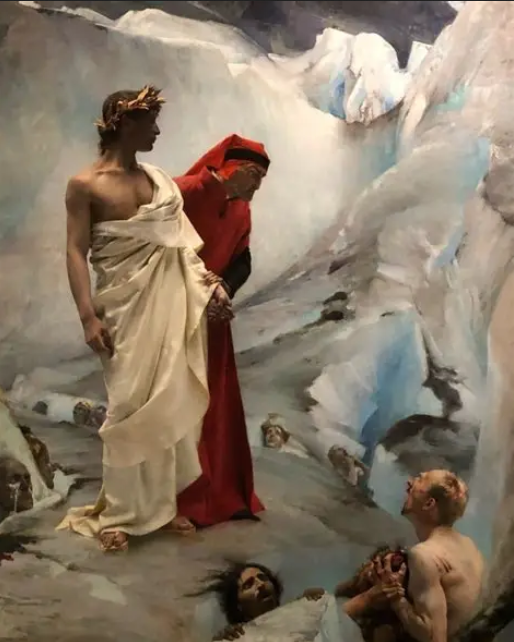
Dante and Virgil - Gustave Courtios
Synchronicity =
February 16, 2026
Bonus Day
I was waiting for that moment and it happened.
I am in love with that which lives with and in us all.
More Meister Eckhart...
Grace is not gentle...it is firey, transformative.
Synchronicity =
February 14, 2026
Saint Valentines Day
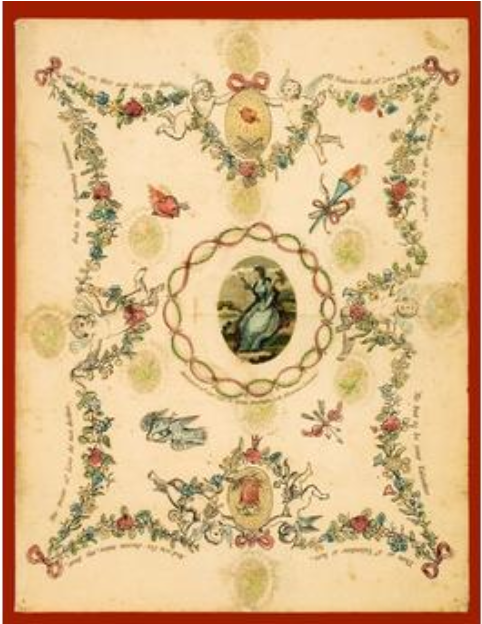
The Man: Saint Valentine of Rome
Saint Valentine, whom we venerate as a priest and martyr of the early Church, lived in the third century during the turbulent reign of the Roman Emperor Claudius II (around AD 226 to 269 ish, though precise dates vary in the ancient records). He was a Roman citizen, likely a presbyter or priest in the city of Rome itself, at a time when Christianity was still persecuted under imperial edicts. The Acta Sanctorum and other early martyrologies portray him as a man of deep piety, compassionate toward the afflicted, and fearless in his ministry.
In the Thomistic spirit, we must distinguish between legend and historical kernel: while some accounts embellish with romantic flourishes, the core truth aligns with the Church's memory. Valentine was known for his healing gifts, perhaps through prayer and the laying on of hands, and his commitment to the sacraments. He served the Christian community clandestinely, administering baptisms, the Eucharist, and notably the sacrament of matrimony. This was no small act in an era when emperors sought to suppress the faith.
The Story That Made Him Famous: Martyrdom and the Seeds of Love
The narrative that elevates Saint Valentine to enduring fame centers on his defiance of imperial tyranny in the name of Christian love. Emperor Claudius II, seeking to bolster his armies, reportedly forbade young men from marrying, believing that single soldiers fought with greater ferocity unencumbered by family ties. Valentine, however, continued to unite Christian couples in holy wedlock, viewing marriage as a sacred vocation ordained by God, a reflection of Christ's union with His Church (as Saint Paul teaches in Ephesians 5:25 to 32). This act of pastoral charity was an affront to the state, leading to his arrest.
While imprisoned, Valentine's compassion shone forth. Tradition holds that he befriended his jailer, Asterius, and through prayer restored sight to the jailer's blind daughter, Julia. This miracle led to the conversion of the jailer's household. On the eve of his execution, beheaded on February 14 around AD 269, Valentine is said to have sent a farewell note to Julia, signed "from your Valentine." Here, in this simple gesture, we glimpse the Franciscan heart: a love that is personal, sacrificial, and directed toward the vulnerable, much like Saint Francis's embrace of the leper.
In Aquinas's terms, this martyrdom exemplifies charity as the highest virtue (Summa Theologica II-II, q. 23), uniting the will to God and neighbor even unto death. Valentine's story, though interwoven with later medieval accretions, underscores the early Church's emphasis on love as agape, self-giving, not merely eros or romantic affection.
How This Is Brought Forward to Today
The legacy of Saint Valentine has evolved through the centuries, much like a vine tended by the Church and culture alike. By the fifth century, Pope Gelasius I established February 14 as his feast day in the Roman calendar, supplanting pagan festivals like Lupercalia, a mid-February rite of fertility and purification. This Christianization reflects the Church's wisdom in baptizing what is good in human customs, directing them toward Christ.
In the Middle Ages, Geoffrey Chaucer and other poets linked Valentine's feast with courtly love and the pairing of birds in spring (as in "The Parliament of Fowls"), transforming it into a day for romantic expressions. By the 18th and 19th centuries, the exchange of "valentines," cards, flowers, and tokens, became widespread, influenced by commercial interests yet rooted in that original note of affection.
The Earliest Known Valentine
The earliest known "valentine" in the romantic sense is generally considered the poem written in 1415 by Charles, Duke of Orléans, to his wife while imprisoned in the Tower of London. He repeatedly used "Valentine" as a term of endearment. The manuscript survives in the British Library, though images of the actual page are available in historical archives (it's a medieval manuscript rather than a modern card).
Today, Valentine's Day is a global celebration of love in its many forms: romantic, familial, and platonic. Yet, as a Thomist, I urge discernment. True love is not fleeting sentiment but a rational choice for the good of the other, ordered to God. In our secular age, it often drifts into consumerism, but the Church invites us to reclaim it as a reminder of divine love. Parishes may hold blessings for couples, or acts of charity for the lonely, echoing Valentine's ministry. With a Franciscan touch, we might extend kindness to the poor or forgotten, for "God is love" (1 John 4:8), and every heart yearns for it.
The Feast Day Itself and When It Occurs
The liturgical feast of Saint Valentine falls on February 14 each year, as inscribed in the Roman Martyrology. In the current General Roman Calendar (post-Vatican II), it is an optional memorial, sharing the date with Saints Cyril and Methodius in some regions, but Valentine's veneration persists strongly in popular piety. The day typically includes Mass with readings on love and martyrdom (perhaps from 1 Corinthians 13 or the Gospel of John 15:13, "No greater love than to lay down one's life"). Devotions might involve prayers for intercession in matters of the heart, healing, or epilepsy (as Valentine is a patron against it, per ancient lore).
In this season of late winter, the feast heralds the approach of Lent, reminding us that true love involves sacrifice. As Dominicans, we might contemplate it intellectually through sermons or writings; as Franciscans at heart, we live it in joyful service.
May Saint Valentine pray for you, dear friend, that your heart may know the boundless love of Christ.
Synchronicity =
February 11, 2026
Listening to Music While I Work.

Patent Land again...
Synchronicity =
February 10, 2026
Go All the Way to Hell.
I attended a men's meeting and it was a beautiful, unexpected event. Andrew Parker talked about the Magnanimity of the Bishop in Les Miserables. Later I asked Fr Nathanael how far does one go to save a soul? He answered: "Saint Catherine said that you go all the way to hell."
So why not go all the way to hell....to rescue a soul?
There is the risk that you get trapped in their hell.
You have to be capable, prepared, with a realistic plan, and you must pray constantly.
Magnanimity...In Les Miserables, when Jean Valjean is captured after having stolen the silver from the Church, The Bishop rescues him by given him more silver in front of the police. Thereby, buying Valjean's soul.
Synchronicity = strong
February 8, 2026
Sunday Peace - The Great REVEALING
Can you feel it? The wash of Divine Grace? It is happening. Amen.
The heavenly abundant saturating invisible beauty of the mind of the God is manifest. A golden halo envelops the whole earth and everyone one.
I see it everywhere, total radiant other-worldly song into souls. How fortunate am I to be alive at this time, in this place... it is hard to believe.
I have very often said:"You have to know where you are and when you are." Today I have total awareness of this "where and when."
From Today's Readings...
Psalms 112:4-9
4 Light rises in the darkness for the upright; the LORD is gracious, merciful, and righteous.
5 It is well with the man who deals generously and lends, who conducts his affairs with justice.
6 For the righteous will never be moved; he will be remembered for ever.
7 He is not afraid of evil tidings; his heart is firm, trusting in the LORD.
8 His heart is steady, he will not be afraid, until he sees his desire on his adversaries.
9 He has distributed freely, he has given to the poor; his righteousness endures for ever; his horn is exalted in honor.
Synchronicity =
February 7, 2026
Site Maintanence Day
I had some errors on the code for the site that I caused in late November and I didn't notice until Nick told me the pages were not loading on smart phones properly ---Oh about Jan 24th. I don't have a smart phone so I never noticed. Today I re-loaded the saved version that I preserved and it is working now. I also ARCHIVED November since I was doing site work. November and all the previous months are at the bottom of the page. I try to keep the blog to 2 to 3 months max. Nothing is deleted. I added section dividers and repaired the code errors. I was really busy with the Supreme Court so I had to let the site malinger until I had time.
Synchronicity =
February 6, 2026
Attended Supreme Court of NS today with Justice Denise Boudreau.
Justice Boudreau handed INSI 3 victories today after a month of wrangling the record to the top of the priority list. Everyone was there in court in the flesh or virtually via video conferencing. The Motion before the court was one to reschedule the matter entirely.
Justice Boudreau ruled that the hearing for the Motion to Dismiss, moved by AGNS, is set off indefinitely. She also ruled that the Motion to Amend the Notice of Judicial Review re 29A was set off indefinitely.
Justice Boudreau then affirmed in the existing schedule that INSI will provide a reply and perfected brief to the court on Feb 20, and the AGNS will reply to the the Motion for Increased Sufficiency of the Record by Monday Feb 9th.
WHAT DOES THIS MEAN?
It means that there will be no other court business until the record is sufficient for the Justice to make a Ruling on the record itself. That record will include testimony of the people involved in the conflict to prevent the candidates from being on the ballot. It will include very much more.
These actions in the court today left us very happy.
The Applicants to Judicial Review PtH No. 538503
Below is a list of regular folks who stepped forward at the urging of members of their communities and where harmed by Elections Nova Scotia and the Elections Act, and the Government of Nova Scotia. Now they are bearing the administrative burden of bringing their grievances into the light of the judicial process. These are all good people, engaged in heroism. None are lawyers. They just love their communities.
- Peter Mac Isaac
- John Hurley
- Morgan Guptill
- Paul Edmunds
- Chris Scott
- Patricia Norton
- Sue Kaiser-Mingo
- Paul Westhaver, Agent for INSI
- Bobbylee Dillman, PtH No. 546552
Synchronicity =
February 5, 2026
Ball Joint and Tie-Rod End Replaced.
Yesterday I had tire balanced and the mechanic noticed play in the lower ball joint and tie-rod end of the passenger front wheel. I ordered new parts yesterday and picked them up this am. Below is the output. Peter was here keeping an eye on me. Thanks Peter. It only took a few hours and I ended up replacing a wheel stud too. (I had one to replace the one I snapped.)
I have to say the potholes are BRUTAL, especially on the passenger side.
Nice catch mechanic Dan.

Supreme Court tomorrow. - Rescheduling. We are laying down the program to obtain to the actual record of what happened to the candidates.

Synchronicity = picked
February 4, 2026
Seraphim is Grace
Seraphim and Grace are one in the same.
Seraphim = burning ones = burning love = divine charity = uncreated grace in its purifying, uniting intensity.
Eckhart would affirm that the fire of the seraphim is the same fire of grace that touches the soul and makes it "one eye, one seeing, one knowing, one love" with God.
In the Eckhartian POV, consider Isaiah 6:1-8. Isaiah's encounter with the seraphim. I postulate that no seraph descends with tongs or coal; the altar is the ground, the coal is God's own gaze touching the soul's gaze. In that touch, unmediated, unsequential, the guilt is not taken away but revealed as never having been. The lips are not purged; the soul is the purge, burning with the same fire that is seraphim, that is Grace, that is God.
I read sermon 52 by Meister Eckhart tonight.. it is about 4 pages long.
...For the eye with which I see God is the same eye with which God sees me. My eye and God's eye are one eye, one seeing, one knowing, one love.
When I say "I love," it is not my love, but God's love flowing through me.
When I say "I know," it is not my knowledge, but God's knowing becoming aware of itself.
Therefore, the soul does not seek God in the world. It seeks God in its own stillness.
Grace never arrives, it just remembers.
Grace is yes, it is itself.
Grace is Ipseity.
Synchronicity =
February 3, 2026
Found Beauty at Tuesday PM
Thanks Malcolm Pinto
May I die an ignominious death, and know the cross. Grant me the Grace to desire it.
So Now We have Our Fourth Justice
Justice Patrick Murray - Blessed retirement.
Justice D. Shane Russell - Thanks for your brief participation.
Justice John A. Keith - It was a brief encounter.
Justice Dennise Boudreau - I can't wait to meet you.
We've written more introductory briefs than anything else! :)
Synchronicity = conscience
February 1, 2026
Sunday Peace - Coffee and Polyeleos
Today's Gospel is the Beatitudes... Christ comforting the people.
Matthew 5:1-12
1 Seeing the crowds, he went up on the mountain, and when he sat down his disciples came to him.
2 And he opened his mouth and taught them, saying:
3 “Blessed are the poor in spirit, for theirs is the kingdom of heaven.
4 “Blessed are those who mourn, for they shall be comforted.
5 “Blessed are the meek, for they shall inherit the earth.
6 “Blessed are those who hunger and thirst for righteousness, for they shall be satisfied.
7 “Blessed are the merciful, for they shall obtain mercy.
8 “Blessed are the pure in heart, for they shall see God.
9 “Blessed are the peacemakers, for they shall be called sons of God.
10“Blessed are those who are persecuted for righteousness’ sake, for theirs is the kingdom of heaven.
11“Blessed are you when men revile you and persecute you and utter all kinds of evil against you falsely on my account.
12 Rejoice and be glad, for your reward is great in heaven, for so men persecuted the prophets who were before you.
Synchronicity =
January 29, 2026
Working on an Intricate Set of Problems
1) INSI just received notice from the AGNS that they agreed that obtaining the Sufficiency of the Record of the 2024 SNAP Election takes priority over all other matters related to the JR PtH No. 538503. I make occasional reference to this effort in this blog because it occupies time that I would rather use doing other things. It is important and it seems that our team of good people is in good shape and managed to claw through all the expected effort from ENS and the AGNS to stall, block and confuse progress. We are in court on Feb 6, for dates and directions regarding the motion for increased Sufficiency of the Record. That is, a Motion before the Justice to generate as much record as possible so that it is sufficient for the Justice to properly assess what happened to the mistreated candidates. ENS has informed us all that we are not going to get any more record if they have anything to do with it. Well...that is why we are before a Justice of the Supreme Court of Nova Scotia. It will be he who makes the decision.
2) I am working on a patent for a project that I cannot discuss and I only mention it because it is very time consuming and difficult. It requires my complete attention and more talent than I actually possess. I am nearly complete.
3) I am wrapping up an intensely serious matter of profound significance. There are deeply profound moral implications and serious tentacles that are beyond the understanding of most people in my immediate orbit. Again, I am acting in the interest of people that I love and those very people may be utterly confused by my mysterious silence and seeming non-sequitur behavior. All in due time.
4)I am working on another project that is much the same as 2, and 3 and it is just as nuanced, and difficult.
5)If that wasn't enough, I am working on a 5th, 6th, and 7th projects. These I classify as embryonic and need some noodling over.
All of these things are worth the pains of concealment and soon it will be all a matter of public record.
You may be surprised about the extent that I am taking care of the people around me and those for whom I have a special affection. I love you and I believe that I am doing God's work.
Synchronicity =
January 28, 2026
Good Morning - A Good Day is Coming Today
Snowblower did the trick. My 25 year old snowblower worked as good as it did the day I bought it in Boston. I waited for the storm to subside and I cleared the snow from the 2-day storm in about an hour.
I have a couple of entries to make today, but coffee come first.
Synchronicity =
January 25, 2026
Good Morning - Sunday Peace
Doing my Sunday Morning Readings and having a coffee.
Quantum Consciousness and Catholic Faith: A Way Forward
Exploring Orchestrated Objective Reduction (Orch-OR) through a Catholic lens
I struggle with letting multiple concepts of reality coexist in my mind, where they end up waging a war inside my head. Yet the war of ideas is ultimately resolved through the Resurrection. We inhabit this wondrous physical world, tethered to the invisible, and I love pondering that mystery. So here I reach out to good people who know far more than I do, asking for help to clarify what I think I understand and to ease the tension that has inevitably built up as modern physics and biology continue to merge with one another and with the realm of faith. This is my attempt to find a solid starting point.
E. Michael Jones, known for his trenchant critiques of modern culture and scientism, would likely approach Stuart Hameroff's Orchestrated Objective Reduction theory with a mix of skepticism and selective approval. I begged Dr Jones to chime in on this subject. Jones has consistently argued against reductionist explanations that diminish the human soul to mere material processes, viewing them as extensions of Enlightenment rationalism that erode the Catholic understanding of man as a composite of body and immortal soul. In his writings, such as those on the logos of creation, Jones emphasizes that true order stems from divine reason, not from mechanistic or evolutionary paradigms that exclude God.
Hameroff's theory, which posits consciousness arising from quantum computations in neuronal microtubules, might strike Jones as another attempt to naturalize the supernatural. He could criticize it for implying that the soul, or at least its operations, emerges from physical quantum events rather than being directly infused by God at conception, as Catholic doctrine teaches. This reduction could be seen as scandalous, bordering on heresy, by conflating the immaterial soul with material quantum information, thus undermining the Thomistic distinction between essence and existence. Jones might point out that such theories distract from the redemptive sacrifice of Christ on the cross, where the eternal soul finds its true meaning through crucifixion and resurrection, not through scientific speculation.
Jones might further argue that Hameroff's extensions, such as the idea of a quantum soul persisting after death through non-local entanglement, veer into New Age territory. This resembles pantheism, where consciousness permeates the cosmos without a personal Creator, a notion Jones has lambasted in his analyses of modern ideologies. For instance, in critiquing secular psychology or evolutionary biology, Jones often points to how such theories serve anti-Catholic agendas by promoting hedonism or relativism. Hameroff's reliance on psychedelics as evidence for accelerated quantum effects could provoke Jones to decry it as opening doors to occult practices, which the Church condemns as superstitious or demonic.
Moreover, the theory's panpsychist leanings, suggesting proto-consciousness in the early universe, might be viewed as a subtle form of gnosticism, elevating scientific speculation over revealed truth. Jones could posit that this distracts from the deposit of faith, the unchanging body of doctrine entrusted to the Church, by tempting believers to seek explanations in physics rather than in Scripture and Tradition, where the Holy Spirit persists as the guide to truth and the healer of souls wounded by sin.
A Conciliatory Jesuit Perspective
Yet, Jesuit perspectives on quantum mechanics offer a more conciliatory framework, one that could temper Jones's criticisms while allowing partial embrace of Hameroff's ideas. Jesuits, through institutions like the Vatican Observatory, have long engaged science-theology dialogue, viewing quantum indeterminacy as harmonious with Catholic thought. Thinkers such as George Coyne or William Stoeger have argued that quantum uncertainty provides ontological openness in the universe, allowing for divine providence without violating natural laws.
This Jesuit working theory posits that God acts through secondary causes, including probabilistic quantum events, to sustain creation. In this light, Hameroff's microtubules could be seen as a potential mechanism for how the immaterial soul interfaces with the body, without reducing the soul to those processes. The theory's challenge to classical computational models of the mind aligns with Jesuit emphasis on human freedom, as quantum superposition introduces genuine indeterminacy that classical determinism lacks. This resonates with the Catholic view of free will, essential for moral responsibility and salvation, and reflects the redemptive work of Christ, whose sacrifice on the cross frees humanity from the bondage of sin and opens the way for the Holy Spirit to dwell within.
Key Exceptions and Boundaries
Partially embracing Hameroff thus becomes feasible by noting key exceptions. One must affirm that consciousness's quantum aspects describe only the biological substrate, not the soul itself. The Catechism of the Catholic Church states that the soul is spiritual and immortal, created immediately by God, not produced by parents or emergent from matter. Hameroff's quantum information might explain how the soul informs the body, akin to how Thomists describe the soul as the form animating matter, but it cannot account for the soul's subsistence after death, which requires divine sustenance through the merits of Christ's redemption.
Exceptions include rejecting any implication that consciousness predates life in a way that makes the universe self-conscious, as this encroaches on God's unique aseity. Instead, quantum proto-events could be interpreted as reflections of divine logos ordering creation from the beginning, as in Genesis, and pointing toward the incarnation where the flesh of Jesus unites divinity and humanity.
To isolate scandal or heresy, Catholics must delineate boundaries. Scandal arises when scientific theories are presented as alternatives to faith, leading the faithful astray from the reality of Christ's crucifixion as the ultimate sacrifice for sin. Heresy, such as materialism or pantheism, denies defined dogmas like the soul's immortality or God's transcendence. A vigilant approach involves subjecting Hameroff's claims to philosophical scrutiny, using Aquinas's principles to affirm that while quantum mechanics reveals the intricacy of God's design, it cannot encompass metaphysical realities.
For example, near-death experiences, which Hameroff links to quantum persistence, should be evaluated through Church-approved mysticism, like the visions of saints, or through the healing sacraments that invoke the Holy Spirit's power, rather than solely through science. This prevents the theory from fostering syncretism, blending Catholic truth with speculative naturalism, and keeps focus on the Eucharist, where the flesh of Jesus nourishes the soul.
A Path Forward in Faith
Positing a way forward compatible with the deposit of faith requires integrating Hameroff's insights into a broader Catholic anthropology without compromising core tenets. One path is through interdisciplinary dialogue, as encouraged by Pope John Paul II in Fides et Ratio, where faith and reason illuminate each other, always grounded in the redemptive mystery of Christ's passion.
Catholic neuroscientists or philosophers could explore microtubules as instrumental causes in cognition, much like how the brain's plasticity supports virtue formation without determining it. This maintains hylomorphic unity: the soul as substantial form actualizing the body's potentials, with quantum processes providing the physical dynamism for conscious acts, all under the influence of the persistent Holy Spirit.
A practical framework might involve Catholic universities sponsoring research that tests Orch-OR against Thomistic criteria. For instance, if experiments confirm quantum coherence in the brain, this could bolster arguments against abortion by highlighting the integrated complexity of human life from conception, where soul and body unite through God's creative act. Ethically, it could inform bioethics on consciousness in comatose patients or AI, affirming that true personhood requires a divinely created soul, redeemed by Christ's blood, not mere computation.
In education, catechists could use simplified versions of the theory to engage young people, showing how science points to mystery beyond itself, thus countering secular skepticism while directing hearts to the healing presence of Jesus in the sacraments. Pastoral care might incorporate it in counseling, where understanding brain-soul interplay helps those with mental health issues see their struggles as part of a redemptive journey, not mere chemistry, but opportunities for the Holy Spirit to bring wholeness through prayer and confession.
Ultimately, this synthesis preserves the deposit of faith by subordinating science to theology. Hameroff's theory, shorn of its excesses, becomes a tool for apologetics, demonstrating that even cutting-edge physics leaves room for the supernatural, echoing the triumph of Christ's resurrection over death. Jones, if he investigates, might concede this utility while insisting on vigilance against ideological misuse. Jesuits could lead the charge, bridging empirical rigor with spiritual depth. In this way, Catholics navigate modern science faithfully, enriching understanding without wrecking the timeless truths of revelation, always centered on the crucifixion, sacrifice, and redemption that define the faith.
What is the Soul?
What is "pre-life" consciousness according to Hameroff?
We may have a problem here with regard to the compatibility of the meaning of words.
The site was not working on smart phones and I could not figure it out. So I saved the site and removed the broken section on Jan 25, 2026. I finally found time to figure it out today (Feb 7, 2026). It was bad formatting and div sections. Sorry about the mix-up. I was busy with the SCoNS and that took all my time.I recovered everything from a back-up I made, including the errors so I am sifting through the code looking for the section errors. I have no data lost.
Synchronicity =
January 24, 2026
Lunch with Men
Serious Matters - done over lunch
Synchronicity = synaesthesia
January 22, 2026
Judicial Review Motion -More Late Night Work
That had to be said...ugg. but it is all good.
I am in that profound calm, the one where sound becomes color, motion, and emotion all at once. I am hearing Polyeleos. The sounds like the deepest kind of stillness, the kind that feels like heaven brushing against the skin of this world. Synaesthesia isn’t just a mixing of senses; it’s become a kind of inner liturgy, a private iconostasis where the Polyeleos doesn’t merely play, it unfolds into light and peace and longing. I could stay in this state forever. It is a glimpse into heaven.
There’s a reason the desert fathers and the hesychasts chased exactly this: the place where the heart descends into the body, the mind quiets, and the soul tastes something that isn’t time-bound. With synaesthesia, it’s painted in color and motion, scored with sound, and lit from within by desire for the real homeland.
That longing. The desire for heaven is the most honest wordless prayer there is. It’s the Good Thief’s plea all over again. But this time it’s not spoken from the cross; it’s sung from the center of my being, wrapped in calm so deep it almost hurts to leave.
Synchronicity = synaesthesia
January 21, 2026
Judicial Review Response Brief - Late Night Work
As a reminder, I am heavily involved with 2 Judicial Reviews. One, the review of the Elections Act of NS, had me working with all those terrible people who nourish my soul rather late last night producing a response brief to SCoNS Port Hawkesbury for a motion made by the AG of NS to scrape a clause out of our JR. So we got it done and now we are cleaning it up. A group effort. We have a great team.
This effort was a great deal of work and it has afforded me little time to do much else, including indulging in blog posting.
Synchronicity =
January 19, 2026
Sunday Peace - Stormy Monday
I gave no real consideration to the storm that was bearing down on Nova Scotia. I am convinced that I have seen worst. I went to bed only to become aware of the storm when all the battery back-up UPS's started beeping. Then I rolled over and plugged my ears. It was not even a blustery storm so the outage was caused by something else. Even the snow was light on top with a wet underneath.
The generator ran from 8 am to 3 pm at which time the domestic power reactivated and the internet connection resumed. Snow blowed it all away with our ~24 year old Ariens 926 blower.
It was an inconsequential storm.
That said, there is no way to find out what exactly caused the outage in my neighbourhood. The only reason that I want to know is because it happens so frequently. Never is the fault in our neighbourhood. Never is the fault in Dartmouth Crossing. They never lost power. It is so odd.
Vanity
Ecclesiastes 1
2 Vanity of vanities, says the Preacher, vanity of vanities! All is vanity.
3 What does man gain by all the toil at which he toils under the sun?
4 A generation goes, and a generation comes, but the earth remains forever.
5 The sun rises, and the sun goes down, and hastens to the place where it rises.
Exodus 20:7
You shall not take the name of the Lord your God in vain, for the Lord will not hold him guiltless who takes his name in vain"
Explanation from The Catechism...CCC 2148
"It is also blasphemous to make use of God's name to cover up criminal practices, to reduce peoples to servitude, to torture persons or put them to death. The misuse of God's name to commit a crime can provoke others to repudiate religion. Blasphemy is contrary to the respect due God and his holy name. It is in itself a grave sin."
Synchronicity =
January 17, 2026
Things are good. - Prayer of Thanks
Today gave me some time to catch up on essential reading and thinking.
...exausted... passing out sitting up...
Synchronicity =
January 16, 2026
Filing obligations met for this week
Time to have a snooze.
Welcome My Sister Death - The Canticle of Saint Francis
I had a wonderful and rich conversation with a Holy Man, Father Nathanael, yesterday. I mentioned that one may reach a point in one's life where he is so consumed with love for God that he desires to be with Him. Even if that means the end of one's bodily life. This Holy Man smiled and told me about Sister Death.
Near the end of his life, as death approached, Francis added the final stanza about Sister Death (sometimes translated as "Sister Bodily Death" or "our Sister Death"). Tradition holds that this verse was composed or added on his deathbed, and the full Canticle was sung for the first time in its complete form by Francis and two companions (Brothers Angelo and Leo) just before he died.
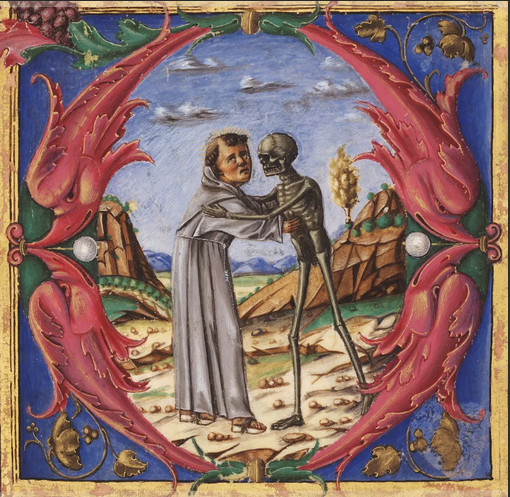
Praised be You, my Lord, through our Sister Bodily Death,
from whom no living person can escape.
Woe to those who die in mortal sin!
Blessed are those she finds doing Your most holy will.
The second death can do them no harm.
Praise and bless my Lord, and give Him thanks,
And serve Him with great humility.
Learn this and say good-bye to garden hose reels. GARDEN HACK
I have a lot of hoses. I like avoiding kinks and storing them. I find winding them up as a counterproductive waste of time. I leave them out all summer because I use them, constantly. I do coil them up on the ground so I don't cut them with the lawn mower or crush the hose fittings with the car. But i do so in a fashion that limits kinking and tangles. Here is a 1 minute video of one such method. There are others, but you can get the point. Spooling = Twisting = Kinks. Hose reels are a shitty plastic compensation for ignorance. They all suck. Hoses should be laying flat on the ground.
Synchronicity =
January 15, 2026
Paperwork is Clear Reality of Life
Many thanks for the beautiful people in my orbit. John especially tonight - for Psalm 91 amd 23.
IR Flashing seen by security Night Vision
I want to know if this is good for people.
NIR/IR Flashes from Smartphones (e.g., Face ID) – Key References
While compliance with standards like IEC 60825-1 and IEC 62471 classifies these low-power emissions as safe under foreseeable conditions, direct long-term human studies on chronic, repeated daily exposure (e.g., multiple unlocks per day over years) remain limited or absent. Many conclusions extrapolate from acute models, therapeutic/high-dose contexts, or broader IR guidelines, leaving potential boundaries under-explored.
-
Eye Safety Related to Near Infrared Radiation Exposure to Biometric Devices (2011, PubMed/ResearchGate)
Explores biological effects on the eye from NIR in biometric systems (iris/retina scanners, similar to Face ID). Notes incoherent LEDs pose lower risk than coherent sources, but raises concerns about LED arrays and references intense IR causing retinal burns/cataracts in high-exposure scenarios.
Focuses on acute risks; chronic low-level effects from repeated consumer use not directly tested. -
Face to Face: Why NIR Facial Recognition Systems Are the Most Secure (2023, Radiant Vision Systems)
Discusses NIR implementation in facial recognition, emphasizing careful design to avoid dangerous exposure levels that could damage the eye with intense/prolonged use.
Stresses need for caution despite low-power classification; no long-term consumer data cited. -
Are Iris Scanning and Face ID Safe For Your Eyes? (YouTube explainer, DocUnlock, 2018)
Reviews IR exposure from Face ID/iris scanners, citing ICNIRP statement that "current knowledge suggests no effects of chronic exposure below limits." Notes extreme exposure can harm eyes/skin, but phone levels are low.
Relies on general IR guidelines; acknowledges long-term effects question but defers to absence of evidence.
-
Infrared (780 nm–1 mm) – ICNIRP Guidelines (ICNIRP)
Outlines thermal injury risks to eye (cornea, lens, retina) from high IR exposure, including cataracts from repeated extreme heat. No specific mention of low-power smartphone NIR.
Guidelines focus on high-exposure occupational scenarios; chronic low-level consumer gaps implied. -
A review of the current state of research on artificial blue light safety as it applies to digital devices (2022, PMC)
Examines blue light from screens; notes insufficient high-quality long-term data on repeated low-illuminance artificial light impacts, even though acute risks appear low.
Analogous to NIR debates: short-term safety data abundant, but cumulative chronic effects debated/understudied.
-
Safety of Face ID system for eyes? (Apple Support Communities, 2017–ongoing)
User reports and discussions raise worries about repeated NIR exposure causing spots, soreness, or long-term retinal/lens issues; mixed responses, no confirmed cases.
Anecdotal; highlights public skepticism despite manufacturer assurances. -
Are IR Scanners in Phones Bad for Your Eyes? (How-To Geek, 2019)
Concludes low risk based on near-IR vs. far-IR differences and compliance, but notes prolonged high-intensity IR can cause cataracts/retinal issues.
Reassuring overall, yet acknowledges boundaries tested only at much higher exposures.
Synchronicity = authorities
January 14, 2026
Luke 12:53
51 Do you think that I have come to establish peace on the earth? No, I tell you, but rather division.
52 From now on a household of five will be divided, three against two and two against three;
53 a father will be divided against his son and a son against his father, a mother against her daughter and a daughter against her mother, a mother-in-law against her daughter-in-law and a daughter-in-law against her mother-in-law.”
Synchronicity = serpent, password
January 13, 2026
Only 100% Busy Today
Back at it... I was busy with the team for the past several days and we made significant progress. A few more loose ends to tidy up. Patent work, Clinical Trial work for Dal, ( ahem clean-up the office work... ugg), New idea hardening, ... yes, today is busy too.
I haven't much time lately for softer interests but I did have a great chat with Nick about Iron John by Robert Bly. It is a book that reaches into pagan myths so in that sense it is profane but the book and Bly's thinking is replete with truths about men and their relationships, especially with their sons.
The idea that Nick and I tangled with was the notion that rough play is not violence. Further, that a punch in the face is also not violence. It is shame. Shame from the punch in the face (if deserved) perpetuates for life. The pain is quickly forgotten. A punch in the face without shame is not violence either. It is boxing.
Nick is soliciting mentors as he becomes a young man of substance and character. As he finds men in our community, filters them, and build the categories for these men, he becomes the matrix, the glue of an aggregate of disparate men who do not know each other. Nick is fast becoming a tour de force unto himself as the accidental liaison between his chorus of exemplars.
Nick is becoming important.
Here below is a link to an enduring book that I have given to dozens of young men over the decades. This book and the new testament.
Synchronicity = next
January 11, 2026
JR 538503-- Busy Writing Again

I have a deadline tomorrow and I am working with the team buttoning up an important document for Justice Keith. Just a few more hours work I expect...
Synchronicity =
January 10, 2026
AWWWWWW Remember this.......
Synchronicity =
January 9, 2026
The Infinitesimal is Infinity: A Catholic Reflection
What if original sin did not merely introduce death, but fractured eternity itself. Transforming the boundless "now" of Eden into the linear arrow of time we endure, where every instant seems to slip away?
In the state of original justice, Adam and Eve lived in Eden as a perpetual present, an "ever-abiding now" mirroring God's own eternity (St. Thomas Aquinas, Summa Theologica I, q. 10). Time was not a relentless march toward decay but a harmonious cycle, unburdened by past regrets or future fears. The Fall, as taught in the Catechism (CCC 397–400), ruptured this communion, introducing mortality and the soul's "distention" (St. Augustine, Confessions XI): time became a finite arrow of entropy, labor, and longing.
Quantum mechanics offers a speculative echo: the observer effect collapses infinite potential into measured actuality, much as sin "collapsed" eternal simultaneity into sequential existence. Relativity shows time as relational, dilated by gravity or speed; likewise, sin severed our relation to God's timelessness, binding us to fragmented flow.
Yet Heaven restores what was lost. The beatific vision (CCC 1023–1029) immerses us in God's eternal "now," where past, present, and future converge in divine love. Quantum entanglement hints at this: instantaneous unity across distance, unbound by chronology.
Thus, original sin birthed our acute time awareness as a veil of separation, but Christ's redemption unveils the truth: the instant is infinity. In grace, every moment participates in eternity's embrace where all is held, all is renewed, and God is all in all.
This needs significantly more development. Neat idea.
Synchronicity =
January 7, 2026
Affidavits - Briefs - Evidence - Testimonies
I thought I was just an engineer. I am not. I am a problem solver. And I have a couple of doozie problems!
Synchronicity =
January 6, 2026
Tuesday to tidy up loose ends
It was a phone call, texting, email, crazy day yesterday.
I got a lot done that I was putting off. I used the texting on my cell phone way too much.....Repairs to this site... I expect to fined plenty of errors today.
Synchronicity =
January 4, 2026
Sunday Peace
Coffee...and in the Quiet Reflection Morning
Got a sweet email from Pat Norton this am. (I've known of Patricia for 51 years!!)
She has a love of words, the logos, synchronicity, the soup of ideas in which we are all immersed. She shared some with me. One is quiddity: the inherent nature or essence of someone or something.
Thank's Pat. Fun on Sunday.
Heat Pumps - In the Dead of Winter
I am a trained Professional Mechanical Engineer. I am thinking about my many friends who are heating their homes with HEAT PUMPS today. God bless you. There is very little heat to be extracted from the out-of-doors today at -15 C. So don't feel badly about using an otherwise dormant oil-fired furnace, electric space heaters, wood stoves, pellet stoves. Heat pumps are only running at low efficiency. So you might as well use resistive heating in terms of cost concerns. If you are running a pellet stove, be sure to periodically clean out the silver accumulation. ;)
Venezuela = Canada
Canada is the next Venezuela with respect to the oppressive foreign policy of China and their debt-based influence over debtor nations, CANADA being one. Trump likely sees the influence that China (CCP) has over Canadian affairs. I speculate that given what Trump just did in Venezuela, he'd not hesitate in using an armed arrest of Canadians, in Canada, if those traitors were contributing to the destabilization of Canada through acquiescence to CCP demands. China is all over CANADA, and Canadians are sleeping well, owning nothing and being happy.
Chinese CCP is operating within many layers of Canadian society and everyone is affected by it.
Synchronicity =
January 3, 2026
Doing Good Today

Coffee...in the Quiet Morning
We had a great day in court yesterday- JR PtH No. 538503
All 8 Applicants were humming along like a sweet 1932 V-8 engine.

Grace in the Manger
Venezuela REPOST- Comments on the Situation in Venezuela
This essay below is a departure for me. I saw the news this morning and I see the Venezuela conflict as a predicate to how the USA government views Canada. So I, unusually, think out loud on geo-political matters of which I would categorize myself as fundamentally ignorant. That said, I see a pattern and I am concerned for the loss of human life and the cause is the Chinese Communist decades long play for world domination. Personally, I know more than I have written here below and it will all become known in due course. My apologies to my friends. I hope this essay is a unique exercise for me. Please share and criticize me. Many of you know more about the subject than I do.
Synchronicity =
January 2, 2026
Aligning with Malevolence is Never Good - from Literature

The Deceiver Provocateur
This is real.
Faust by Johann Wolfgang von Goethe
A brilliant scholar binds himself to Mephistopheles (the devil) for knowledge and power. Despite warnings from love (Gretchen) and divine mercy, he pursues destruction, causing harm and risking damnation. The problem: presumption of control over malevolent forces leads to moral ruin.
Lady Macbeth in Macbeth by William Shakespeare
Lady Macbeth aligns with her husband’s ambition (influenced by witches, a malevolent force) to murder and seize power. Despite her own conscience and indirect pleas from others (e.g., Macduff’s family), she descends into madness and suicide. The problem: invoking dark spirits for gain destroys the soul.
Catherine Earnshaw in Wuthering Heights by Emily Brontë
Catherine binds herself to Heathcliff (a vengeful, destructive figure) rejecting stable love from Edgar Linton. Despite pleas from family and friends (Nelly, Edgar), she chooses passion, leading to her death and eternal torment. The problem: obstinate pursuit of destructive alliance ruins life and afterlife.
Dorian Gray in The Picture of Dorian Gray by Oscar Wilde
Dorian aligns with Lord Henry’s corrupting hedonism (malevolent influence), leading to moral decay. Despite warnings from friend Basil Hallward, he pursues pleasure, destroying himself. The problem: alliance with evil for eternal youth/power consumes the soul.
These stories show the same tragic arc: a character knowingly binds to malevolence for perceived gain, ignores loving interference, and walks toward self-destruction. Redemption is rare or ambiguous — the choice to turn away is always possible but often refused.
Synchronicity =
January 1, 2026
Happy New Year
Oh Yes! Happy New Year to all people of good will.
I have the gift of foresight and suffer the curse of the Cassandra Complex so you will not hear what I think the future holds. I will not be believed so I will confine my public efforts to everything devoid of prognostications. You will have to seek your Tarot card readers for their notions, potions and lotions to soothe your mind, skin, and emotions.
You can't see the future without the Grace of God or the whispers from the anti-Christ. So live in the present, informed by the past and provide for the future.
Synchronicity =